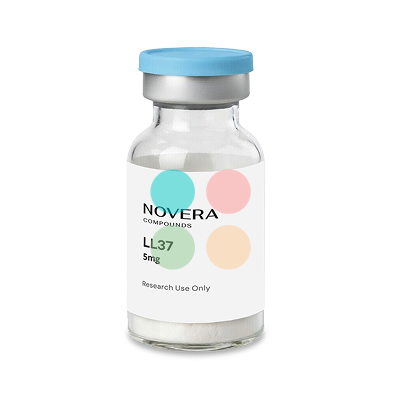
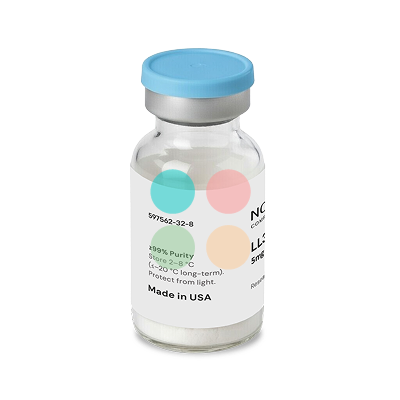
LL-37 is a 37-amino acid antimicrobial peptide derived from the human cathelicidin protein hCAP-18, studied across disciplines for its bactericidal action against various pathogens, its wound healing activity, and its capacity to modulate immune responses in inflammatory and autoimmune disease models. Researchers investigating innate immunity, antimicrobial peptides, or inflammatory pathways can buy LL-37 peptide through FillerSupplies.com, where it is available in lyophilized powder form for laboratory applications.
This compound is sold strictly as a research-use-only product. LL-37 is not approved by the FDA for therapeutic use in humans, and all data discussed below derive from preclinical animal models or in vitro experiments. Licensed professionals seeking to buy LL-37 (CAP-18) for investigation into microbial membranes, immune system signaling, or tissue repair will find detailed mechanistic and comparative information throughout this page.
General Information About LL-37
The peptide LL-37 takes its name from its 37 residues, beginning with two leucines: LLGDFFRKSKEKIGKEFKRIVQRIKDFLRNLVPRTES. Its theoretical molecular weight is approximately 4,493.32 Da, confirmed by mass spectrometry. Twenty-seven of those 37 residues carry a charge or polar side chain, giving the molecule a net positive charge of +6 to +7 at physiological pH. That cationic, amphipathic character drives the peptide’s transition from a random coil in aqueous solution to an α-helical conformation upon contact with phospholipid membranes, enabling binding and membrane disruption.
hCAP-18, the precursor protein, is stored in the secondary granules of human neutrophils and released at sites of infection or tissue damage. Proteinase 3 in neutrophils and kallikreins in keratinocytes cleave the proprotein to liberate the active C-terminal fragment. Epithelial cells, macrophages, and other immune cells also produce hCAP-18, with expression inducible by inflammatory signals and vitamin D receptor activation.
Once released, the peptide LL-37 binds negatively charged bacterial lipopolysaccharides (LPS) and lipid A through electrostatic interactions. It then inserts into microbial membranes and forms pores, a process that collapses transmembrane potential and kills target cells. LL-37 also enhances lysozyme action against gram-positive bacteria by disrupting their cell wall architecture, and it can disrupt bacterial biofilms that protect colonies from treatment. Beyond direct killing, the compound neutralizes free LPS, reducing toll-like receptor 4 (TLR4) activation and downstream pro-inflammatory cytokine release.
Stability in protease-rich environments is limited. In human serum, the peptide’s half-life spans minutes to approximately 1–2 hours unless protected by delivery systems such as hydrogels or nanoparticle conjugates. LL-37 is resistant to proteolytic degradation in simple aqueous solution, but wound exudate and plasma proteases accelerate its breakdown. This distinction matters for experimental design: researchers must account for the biological matrix when interpreting dose-response data.
LL-37 Use in the Research Setting
FillerSupplies supplies LL-37 as a lyophilized powder intended for research and laboratory use only. The sections below summarize published research findings across antimicrobial, wound healing, immunomodulatory, autoimmune, and oncological applications.
Antimicrobial Activity Against Pathogens
LL-37 exhibits bactericidal action against a broad range of gram-negative bacteria, gram-positive organisms, fungi, and enveloped viruses. Its potency depends on ionic conditions: against E. coli ML-35p, Turner et al. reported in 1998 in Antimicrobial Agents and Chemotherapy a minimum inhibitory concentration (MIC) of approximately 0.6 μg/mL at 0 mM NaCl, rising to 7.6 μg/mL at 100 mM NaCl.
“Although generally less potent than PG-1, LL-37 showed considerable activity (MIC, <10 μg/mL) against Pseudomonas aeruginosa, Salmonella typhimurium, Escherichia coli, Listeria monocytogenes, Staphylococcus epidermidis, Staphylococcus aureus, and vancomycin-resistant enterococci, even in media that contained 100 mM NaCl.” (Turner et al., 1998)
Against Pseudomonas aeruginosa standard strains, MIC values typically fall in the 16–64 μg/mL range; multi-drug resistant and pan-drug resistant isolates require 32 to >128 μg/mL. Acinetobacter baumannii standard strains show MICs of 4–32 μg/mL, with resistant strains sometimes exceeding 250 μg/mL.
Shorter cathelicidin fragments offer distinct profiles. Luo et al. reported in 2017 in Frontiers in Microbiology that KR-12 and KE-18, truncated analogs of LL-37, achieved MICs of approximately 2–5 μg/mL against E. coli and S. aureus, lower than the 9.8 μg/mL measured for the full-length peptide against E. coli ATCC 25922 in the same assay. Protegrin-1 (PG-1), a porcine antimicrobial peptide, routinely achieves MICs below 1 μg/mL in high-salt media where LL-37 loses potency. The tradeoff: LL-37 possesses immunomodulatory functions that these more potent but narrower peptides lack.
Citation capsule: In a 2017 comparative study published in Frontiers in Microbiology, Luo et al. found LL-37’s MIC against E. coli ATCC 25922 was 9.8 μg/mL, while the fragment KR-12 achieved an MIC of approximately 2–5 μg/mL against the same strain, demonstrating that shorter analogs can exceed the parent molecule’s direct antimicrobial potency.
Wound Healing and Tissue Repair
LL-37 may enhance wound healing by promoting angiogenesis, endothelial cell proliferation, and re-epithelialization. A 2011 study published in Peptides (ScienceDirect) demonstrated that topical application of synthetic LL-37 in dexamethasone-treated mice increased vascularization and re-epithelialization in human skin wounds modeled in vivo. The compound induced formation of tubule-like structures by endothelial cells in vitro and stimulated their proliferation and migration.
LL-37 promotes endothelial cell proliferation during wound healing through growth factor receptor transactivation, particularly via epidermal growth factor receptor (EGFR) signaling. It enhances vascularization in skin and organ tissues by upregulating vascular endothelial growth factor (VEGF) and hypoxia-inducible factor 1-alpha (HIF-1α). In a pressure ulcer mouse model, Luo et al. (2020, Journal of Bioactive and Compatible Polymers) showed that 20 μg of LL-37 encapsulated in a chitosan hydrogel reduced residual ulcer area to approximately 48% of baseline by day 15, compared with untreated controls. Capillary density and epithelial thickness both increased.
Xi et al. published findings in 2024 in Peptides showing that LL-37 accelerated full-thickness wound closure in diabetic mice. Under high-glucose conditions, the peptide promoted keratinocyte migration and activated TFEB-dependent autophagy, with upregulation of ATG5, ATG7, and Beclin-1. LL-37 may reduce apoptosis in keratinocytes during inflammation through these autophagy-related mechanisms.
In MRSA-infected surgical wounds in BALB/c mice, combined topical and systemic LL-37 administration reduced bacterial load from approximately 7.8×10⁷ CFU/g (untreated) to 6.9×10⁵ CFU/g, a reduction of roughly two orders of magnitude. Granulation tissue quality, collagen organization, and VEGF expression improved to levels comparable with teicoplanin treatment.
|
Model
|
LL-37 Dose / Concentration
|
Main Outcome
|
|
Diabetic mice, full-thickness wounds (Xi et al., 2024)
|
In vitro: 8–16 μM; in vivo: topical
|
Accelerated closure; TFEB-dependent autophagy upregulated; keratinocyte migration enhanced under high glucose
|
|
Pressure ulcers, mice (2020)
|
20 μg topical (LL-37/chitosan hydrogel)
|
Residual ulcer area ~48% by day 15; VEGF and HIF-1α increased; capillary density and epithelial thickness improved
|
|
MRSA-infected surgical wounds, BALB/c mice
|
Topical + systemic LL-37
|
Bacterial CFU reduced by ~2 logs; improved neovascularization, collagen organization, re-epithelialization
|
|
Dexamethasone-impaired wounds, mice (2011)
|
Synthetic LL-37, topical
|
Increased vascularization, endothelial proliferation, tubule-like structure formation
|
Immune System Modulation
LL-37 functions as a signaling molecule that recruits immune cells to infection sites via the formyl peptide receptor 2 (FPR2) and other G-protein-coupled receptors. Neutrophils, eosinophils, and monocytes respond to the peptide’s chemotactic gradient. It also induces expression of chemokines such as IL-8 (CXCL8) and MCP-1 (CCL2), amplifying the local inflammatory response when pathogen clearance is needed.
At the same time, the compound modulates immune responses based on inflammatory environments. LL-37 interacts with TLR4 to influence inflammatory outcomes: it neutralizes LPS binding to CD14, dampening TLR4 signaling and thereby reducing downstream production of pro-inflammatory cytokines. LL-37 can suppress pro-inflammatory cytokines like IL-6 and IL-8 under certain priming conditions, while under different exposure sequences it amplifies IL-8 and IL-12 secretion. LL-37 reduces macrophage activation triggered by lipopolysaccharide through this LPS-neutralizing mechanism.
“LL-37 neutralizes LPS and modulates toll-like receptor signaling in a context-dependent manner: it dampens TNF-α and IL-6 release from macrophages pre-exposed to the peptide before LPS challenge, yet enhances certain chemokine outputs when cells encounter LL-37 after TLR activation.”
The compound enhances immune response by interacting with cell surface scavenger receptors, potentially altering clathrin-mediated endocytosis and intracellular signaling pathways. Through these receptors, LL-37 can facilitate uptake of foreign nucleic acids and self nucleic acids, activating interferon regulatory factors and type I interferon production. This dual capacity positions it as one of the immune modulating molecules that bridges innate immunity and adaptive immune activation, with implications for both protective defense and autoimmune pathology.
Autoimmune and Inflammatory Disease Research
In psoriasis, LL-37 plays a well-documented role as an autoantigen. The peptide binds self-DNA and self-RNA to form complexes that activate plasmacytoid dendritic cells via TLR7 and TLR9, triggering type I interferon production. A 2025 study published in Journal of Autoimmunity found that native and post-translationally modified forms of LL-37 (citrullinated and carbamylated variants) colocalize with neutrophil extracellular traps in psoriatic skin, a pattern absent in healthy controls. T cells from psoriasis patients recognize these modified forms, and CD4+ responses to native and carbamylated LL-37 correlate with disease severity as measured by PASI scores. This cathelicidin promotes inflammation through these autoimmune loops when the regulatory balance shifts.
LL-37 has also been studied for its role in rheumatoid arthritis. In arthritic joints, elevated levels of the peptide correlate with local concentrations of IL-6, TNF-α, and IL-1β. LL-37 levels correlate with disease severity in autoimmune conditions more broadly, and high LL-37 levels may reduce inflammation in autoimmune diseases under specific conditions by suppressing certain inflammatory pathways. Research into the gastrointestinal tract suggests relevance to inflammatory bowel disease and gastrointestinal ulcers, where the peptide appears in chronic ulcer epithelium and influences colonic subepithelial myofibroblasts.
Important to Know: All autoimmune and inflammatory disease data remain preclinical. Human evidence is limited to ex vivo and biopsy-derived cell studies. LL-37 has complex effects on inflammation and cell growth: its immunomodulatory effects can influence inflammatory signaling in either direction depending on the cell type, modification state, and cytokine environment. No therapeutic applications are approved.
Cancer Cell Research Applications
LL-37 has been investigated across multiple cancer cell lines, and the reported effects run in both directions depending on tissue origin and receptor expression: the peptide has been described as reducing viability in some carcinoma lines while promoting proliferation in others, which is why LL-37 oncology work is read cautiously and per tissue type rather than as a single effect.
Citation capsule: A 2024 study in Scientific Reports by researchers conjugating LL-37 to Fe₃O₄ nanoparticles (~34–40 nm diameter) found concentration-dependent inhibition of K562 leukemia cell proliferation via the p53/Bax/Bcl-2 apoptotic pathway, with the conjugate outperforming unconjugated nanoparticles alone.
The picture is not uniformly anti-tumorigenic. In hepatocellular carcinoma (HCC) cell lines PLC/PRF-5 and Huh7, overexpression of hCAP-18/LL-37 increased the proportion of cancer cells in S phase and promoted proliferation; silencing the gene reversed this effect. In ovarian cancer models, LL-37 stimulated migration and invasion through Matrigel in a process requiring formyl peptide receptor-like 1 (FPRL1) and downstream activation of MAPK, JAK/STAT, and activated kinase cascades. These findings underscore that the peptide’s effect on cancer cells depends on receptor context, particularly FPRL1 and EGFR expression, and on the specific intracellular signaling pathways engaged in each tissue.
Buy LL-37 Online at FillerSupplies.com
Researchers and licensed professionals looking for LL-37 peptide for sale can purchase research-grade compound directly from FillerSupplies.com. Whether you need to buy LL-37 cap-18 peptide for antimicrobial screening, wound healing models, or immune modulation studies, FillerSupplies provides reliable sourcing backed by nearly two decades in the market. Reputable suppliers provide batch-specific HPLC analysis and Certificates of Analysis, and independent third-party testing is recommended for verifying peptide purity, as the FDA warns about immunogenicity and purity concerns related to LL-37. Purity guarantees and human safety data are often lacking for gray market LL-37 products, making supplier selection a key consideration when purchasing LL-37 online.
-
Authentic, certified products; original, quality-controlled compounds, warehouses worldwide.
-
11 years of reliability & trust; established supplier on the market since 2006.
-
Temperature-controlled shipping; thermal packaging with ice gel / cold packs preserves stability.
-
Express worldwide shipping; next-day dispatch, global delivery.
-
Best wholesale prices; tiered bulk discounts and price-match guarantee.
-
Privacy guaranteed; expert support at (888) 392-6640, WhatsApp and email, Mon-Fri 10am-6pm EST.
-
Supplied for research use only, to licensed professionals.
All LL-37 products from FillerSupplies.com are intended for research and laboratory use only. They are not for human therapeutic administration.
Related research peptides available at FillerSupplies.com: Thymosin Alpha-1, KPV, TB-500.
FAQ
What Is the Mechanism of Action of LL-37 Peptide?
LL-37 binds to bacterial lipopolysaccharides through electrostatic interaction between its cationic residues and negatively charged lipid components. Upon contact with microbial membranes, the peptide transitions from a random coil to an α-helical conformation, inserts into the lipid bilayer, and forms pores that collapse transmembrane potential. Beyond direct membrane disruption, it neutralizes free LPS and modulates toll-like receptor signaling in immune cells.
How Does LL-37 Compare to Other Antimicrobial Peptides?
Protegrin-1 (PG-1) is more potent under high-salt conditions, with MICs often below 1 μg/mL where LL-37 requires 7–64 μg/mL depending on the organism. Shorter cathelicidin fragments such as KR-12 achieve lower MICs against E. coli (2–5 μg/mL vs. ~9.8 μg/mL for the full-length peptide). The tradeoff is functional breadth: LL-37 uniquely combines antimicrobial, chemotactic, and immunomodulatory properties that these narrower peptides do not share.
What Are the Storage Requirements for LL-37 Research Peptide?
Lyophilized LL-37 should be stored at -20°C or lower in a desiccated environment. Avoid repeated freeze-thaw cycles. Reconstitute in sterile water or phosphate-buffered saline immediately before use, and aliquot any unused reconstituted peptide into single-use volumes stored at -20°C to minimize degradation.
Is LL-37 Peptide a Prohibited Substance in Sports?
LL-37 is not approved for human use by any regulatory agency. Its classification under anti-doping frameworks may fall under prohibited immune-stimulant or peptide categories depending on the sport and governing body. Researchers should be aware that any use outside of laboratory settings raises both regulatory and ethical concerns.
What Research Dosage Ranges Are Reported for LL-37?
In vitro antimicrobial assays typically use concentrations of 0.6–64 μg/mL depending on the organism and salt conditions. Wound healing studies in mice have used 20 μg topically (hydrogel formulations). Cancer xenograft models have employed 10–20 mg/kg systemically. All dose data come from animal or cell culture experiments; no human dosing guidelines exist.
How Should LL-37 Lyophilized Powder Be Reconstituted?
Dissolve the lyophilized powder in sterile, endotoxin-free water or an appropriate buffer at room temperature. Gently swirl; do not vortex vigorously, as excessive mechanical stress can affect α-helical structure. Allow full dissolution before diluting to working concentration, and use freshly prepared solutions within the same experimental session when possible.
Where Can I Buy LL-37 Peptide for Research Use?
Licensed researchers can buy LL-37 peptide from FillerSupplies.com, which offers LL-37 peptide for sale with temperature-controlled shipping and batch-specific documentation. Purchasing LL-37 online may introduce safety and purity risks if sourced from unverified vendors, so always request a Certificate of Analysis and consider independent third-party testing.