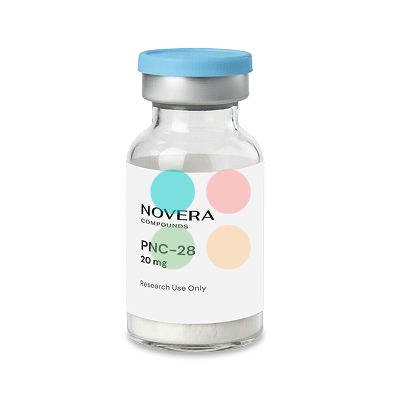
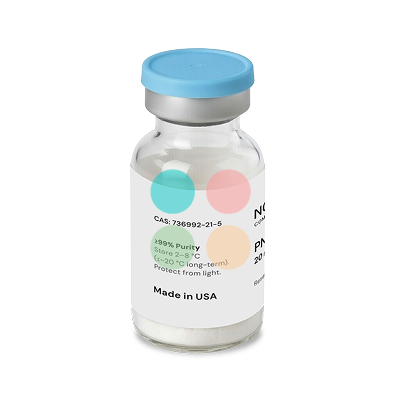
PNC-28 is a synthetic peptide derived from residues 17–26 of the human p53 protein, fused to a membrane crossing penetratin sequence. Studied primarily in pancreatic cancer research, this compound selectively targets cancer cells by binding membrane-expressed HDM-2 and inducing necrosis through pore formation in cell membranes-a mechanism that leaves non cancerous cells unharmed. Researchers investigating peptide-based cytotoxicity, HDM-2 interactions, and novel necrotic pathways in experimental models rely on PNC-28 as a tool compound for preclinical analysis.
PNC-28 is sold exclusively through scientific supply companies for research purposes and is not approved for human or veterinary use. Every claim in this description reflects preclinical laboratory research; no data establish this compound as a safe or effective cancer treatment in patients. Licensed professionals seeking to buy PNC-28 for controlled research environments will find the specifications, published study data, and storage information below.
General Information About PNC-28
PNC-28 is constructed by covalently linking the MDM 2 binding domain of human p53-specifically binding domain residues 17 through 26-to a leader sequence derived from the Antennapedia homeodomain of Drosophila, commonly known as penetratin. The p53-derived fragment contributes 10 amino acids, while the membrane crossing penetratin sequence adds approximately 22–23 residues, yielding a total peptide length of roughly 30–32 amino acids. Its molecular weight is 3,509.13 g mol⁻¹, with an empirical formula of C₁₆₄H₂₅₅N₄₇O₃₇S.
The mechanism of action centers on domain residues 17 26 of the p53 protein, which fold into a conformation matching the natural HDM-2-bound state. Key hydrophobic residues-Leu22, Trp23, and Leu26 in the p53 fragment-interact with HDM-2 residues including Ile99, Leu54, Ile61, and Met62. Cancer cells express HDM-2 on their plasma membranes, whereas normal cells do not, granting PNC 28 its selectivity. Once the compound binds membrane HDM-2, the penetratin leader sequence facilitates lateral aggregation and transmembrane pore formation, resulting in rapid necrosis rather than apoptosis.
Dedicated serum half-life measurements for this molecule in human systems have not been published. In vitro functional stability, however, is well established: PNC 28 produces detectable LDH release (a necrosis marker) as early as 4 hours post-treatment and sustains cytotoxic activity over 24-hour and 72-hour assay windows. The lyophilized powder form remains stable at −80 °C for up to 2 years and at −20 °C for up to 1 year when protected from moisture and heat, according to vendor specifications.
PNC-28 Use in the Research Setting
PNC-28 is supplied as a lyophilized powder requiring reconstitution with an appropriate solvent before use in laboratory assays; it is intended for laboratory research use only.
Cancer Cell Selectivity
One of the most consistently reported properties of PNC 28 is its ability to kill cancer cells while sparing non cancerous cells. In a study by Michl et al. published in the International Journal of Cancer in 2006, the peptide destroyed approximately 90–100% of BMRPA1.Tuc3 rat pancreatic cancer cells over three days of treatment, while untransformed BMRPA1 acinar cells showed no growth inhibition at identical concentrations. This selectivity stems from HDM-2 expression on cancer cell membranes-a feature absent in normal cell populations.
PNC-28 shows selective cytotoxic effects in cancer cell lines across multiple experimental models. Binding assays using immunoblot and fluorescent-labeled peptide localization confirm that the compound attaches to HDM-2 on cancer cell membranes but shows no binding on normal cell surfaces. Compared to PNC-27, which incorporates p53 residues 12–26 (a 15-amino-acid fragment), PNC 28 uses a shorter 10-residue p53 segment yet achieves comparable potency in many pancreatic cancer models. The shorter length may offer advantages in synthetic yield and reduced non-specific interactions, though PNC-27’s additional residues can broaden binding in certain cell types.
Membrane Disruption Mechanism
PNC-28 is used to study peptide interactions with cancer cell membranes through a distinctive necrotic pathway. After binding membrane-expressed HDM-2, the peptide–HDM-2 complexes undergo lateral diffusion, dimerize, and multimerize to form discrete transmembrane pores. Transmission electron microscopy provides direct evidence: in a 2024 review published in PMC, researchers documented visible pores in MIA-PaCa-2 cell membranes after just 15 minutes of exposure to 100 µg/mL of the compound.
The process is temperature-dependent, consistent with a membrane fluidity requirement for pore assembly. Once pores form, intracellular enzymes-including lactate dehydrogenase (LDH)-leak through the compromised cell membranes, and osmotic disruption follows rapidly. This molecular pathway from HDM-2 binding to membrane permeabilization distinguishes the compound from agents that trigger caspase-mediated apoptosis.
PNC-28 induces necrosis in human pancreatic cancer cells through a pore-formation mechanism: at 300 µg/mL, nearly 100% cell death in MiaPaCa-2 cells ran through rapid LDH release without the rise in pro-apoptotic proteins that marks p53-induced apoptosis – necrosis rather than apoptosis (Bowne et al., 2008, Annals of Surgical Oncology).
Pancreatic Cancer Research Applications
PNC-28 is used in preclinical models of pancreatic cancer across both in vitro and in vivo settings. Bowne and colleagues reported in 2008 that MiaPaCa-2 human pancreatic carcinoma cells treated with PNC-28 died in a dose-dependent way, with membrane pore formation preceding the release of lactate dehydrogenase. PNC 28 blocks growth of lethal pancreatic cancer cell lines through its necrotic mechanism, and sub-threshold doses produce partial and slower killing, establishing clear dose dependence.
In vivo, Michl et al. demonstrated in 2006 that nude mice bearing subcutaneous xenografts of BMRPA1.Tuc3 pancreatic tumor cells responded markedly to treatment delivered directly via mini-osmotic pumps. Approximately 2 mg per mouse was delivered over 14 days at a rate of ~0.25 µL/hr. When the compound was administered simultaneously with tumor implantation, complete tumor destruction or growth blockade occurred; post-establishment treatment produced substantial tumor shrinkage and significantly slowed growth relative to controls.
Delivery in animal studies has employed both mini-osmotic pumps implanted subcutaneously and intraperitoneal injection routes. For in vitro protocols, researchers typically add reconstituted PNC 28 to serum-supplemented medium and measure LDH release for necrosis quantification, alongside caspase assays to confirm the absence of apoptotic signaling.
|
Peptide
|
p53 Residues
|
Leader Sequence
|
In Vitro Potency (Pancreatic Cancer Cells)
|
Effect on Normal Cells
|
|
PNC-27
|
12–26 (15 aa)
|
Penetratin / MRP
|
~100% kill of MiaPaCa-2 at 100–300 µg/mL over 2–3 days
|
No significant effect on untransformed cells
|
|
PNC-28
|
17–26 (10 aa)
|
Penetratin / MRP
|
~100% kill at 300 µg/mL after 3 days; LDH release within 4–24 h
|
No effect on untransformed counterparts (e.g., BMRPA1 acinar cells)
|
Necrosis Induction Pathways
The distinction between necrosis and apoptosis is central to understanding how PNC 28 works. When the compound is applied externally to cancer cells with its penetratin leader sequence intact, LDH release begins within approximately 4 hours and increases continuously over 24 hours. No elevation of caspase 3/7 activity or annexin V staining-hallmarks of apoptotic cell death-is observed under these conditions.
An intriguing contrast emerged from a 2008 study: when the p53 fragment (residues 17–26) was expressed intracellularly without the penetratin leader (via plasmid transfection), apoptotic markers appeared instead of necrotic ones. The penetratin domain, therefore, is not merely a delivery vehicle-it is integral to the membrane pore formation process that defines the necrotic pathway. Electron microscopy confirms structural membrane disruption within minutes, with rapid cellular content release following pore assembly.
Important to Know: PNC-28 induces necrosis in human pancreatic cancer cells exclusively in preclinical experimental settings. Preclinical studies do not establish PNC-28 as a safe or effective cancer treatment in humans. All data referenced are from in vitro cell culture or animal tumor models, and no human clinical trials have been conducted with this compound. Research use remains limited to controlled research environments under appropriate institutional oversight.
Experimental Dosing and Administration Routes
Published in vitro studies have employed research concentration ranges of 100–300 µg/mL applied to cancer cell lines including MiaPaCa-2 and BMRPA1.Tuc3 over 1–3 day treatment periods. At the highest tested concentration of 300 µg/mL, near-total cell kill occur by day three, while lower concentrations produce partial and slower cytotoxicity-useful for dose-response analysis. Control peptides such as PNC-29 and leaderless p53 fragments served as negative reference compounds.
For in vivo administration, approximately 2 mg per nude mouse was delivered via mini-osmotic pump over 14 days, though intraperitoneal and intratumoral injection routes have also been tested. Each storage method matters for maintaining compound integrity: the lyophilized powder should be stored at −80 °C (stable up to 2 years) or −20 °C (up to 1 year), protected from moisture and heat. Reconstitution into a stock solution uses water or another appropriate solvent at concentrations up to approximately 25 mg/mL; aliquots should be prepared to prevent repeated freeze-thaw cycles, and any unused material should remain sealed at −80 °C (stable ~6 months) or −20 °C (~1 month).
In nude-mouse xenograft models reported by Michl et al. in the International Journal of Cancer (2006), approximately 2 mg of PNC-28 delivered per animal via osmotic pump over 14 days completely blocked pancreatic tumor growth when administered simultaneously with tumor implantation, with no observable toxicity to surrounding normal tissue.
Buy PNC-28 Online at FillerSupplies.com
FillerSupplies.com offers PNC 28 20mg quantities for qualified researchers conducting pancreatic cancer research, membrane biology studies, and peptide-mediated cytotoxicity analysis. Ordering PNC-28 requires compliance with institutional guidelines, and secure ordering protects institutional information and confidentiality. Legitimate suppliers provide batches with a Certificate of Analysis verifying purity levels, and it is important to evaluate suppliers based on quality assurance indicators when you purchase from established research-chemical vendors that provide analytical documentation.
-
Authentic, certified products – original, quality-controlled compounds, warehouses worldwide.
-
11 years of reliability & trust – established supplier on the market since 2006.
-
Temperature-controlled shipping – thermal packaging with ice gel / cold packs preserves stability.
-
Express worldwide shipping – next-day dispatch, global delivery.
-
Best wholesale prices – tiered bulk discounts and price-match guarantee.
-
Privacy guaranteed; expert support at (888) 392-6640, WhatsApp and email, Mon–Fri 10am–6pm EST.
-
Supplied for research use only, to licensed professionals.
PNC 28 is available in 20 mg quantities and is intended for laboratory research use only-not for human or veterinary use, clinical applications, or therapeutic formulation for patients.
Related research peptides available at FillerSupplies.com: FOXO4-DRI, SS-31.
FAQ
What Is PNC-28 and How Does It Work?
PNC-28 is a synthetic peptide derived from the p53 protein (residues 17–26) fused to a membrane crossing penetratin sequence. It binds HDM-2 expressed on cancer cell membranes, triggering transmembrane pore formation and necrosis. The compound does not activate caspase-mediated apoptosis when applied externally with its leader sequence.
Is PNC-28 Safe for Laboratory Use?
When handled according to standard peptide safety protocols in controlled research environments, PNC-28 presents no unusual laboratory hazards beyond those associated with bioactive research compounds. It is not approved for human or veterinary use, and preclinical studies do not establish it as a safe treatment for patients. Researchers should follow institutional biosafety guidelines for handling and disposal.
How Does PNC-28 Compare to PNC-27?
Both peptides share the same penetratin leader sequence and induce necrosis via membrane pore formation after binding HDM-2. PNC-27 incorporates p53 residues 12–26 (15 amino acids), while PNC-28 uses residues 17–26 (10 amino acids). In pancreatic cancer cell lines, both achieve near-complete cytotoxicity at 300 µg/mL, though PNC-28's shorter length may offer advantages in synthetic yield and reduced non-specific interactions.
What Are Typical Research Concentrations for PNC-28?
Published in vitro studies used concentrations ranging from 100 µg/mL to 300 µg/mL applied to cancer cell lines over 1–3 day periods. In vivo dosing in nude-mouse models involved approximately 2 mg per animal delivered via osmotic pump over 14 days. Exact quantity and volume requirements vary by experimental design and cell line sensitivity.
How Should PNC-28 Be Stored and Reconstituted?
The lyophilized powder should be stored at −80 °C (stable up to 2 years) or −20 °C (up to 1 year), protected from moisture and heat. Reconstitute with water or an appropriate solvent to prepare a stock solution at concentrations up to ~25 mg/mL. Aliquot to avoid repeated freeze-thaw cycles; unused material in solution remains stable at −80 °C for approximately 6 months.
Is PNC-28 a Prohibited Substance?
PNC-28 is not approved for clinical applications, therapeutic use, or administration to patients or animals outside of approved research protocols. Ordering PNC-28 requires compliance with institutional guidelines. Researchers should consult their institutional review boards and applicable regulations before incorporating the compound into experimental models.
Where Can I Buy PNC-28 for Research?
You can buy PNC-28 from FillerSupplies.com, where it is available in 20 mg quantities with documentation including a certificate of analysis. Purchase from established research-chemical vendors that provide analytical documentation to ensure consistency and purity. Secure ordering protects institutional information and confidentiality.