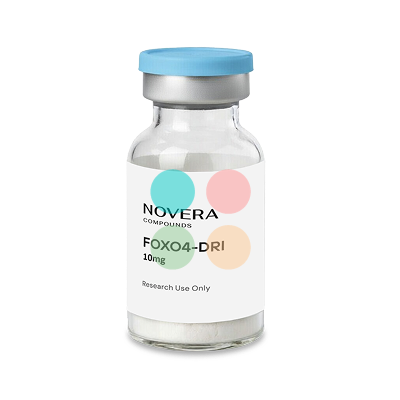
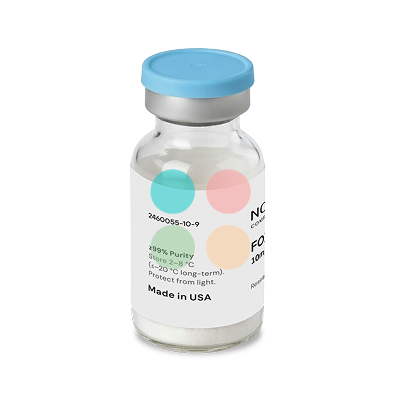
General Information About FOXO4-DRI Peptide
FOXO4-DRI peptide is a synthetic version of the FOXO4 protein that contains D-amino acids instead of L-amino acids. It may prevent the binding of the FOXO4 protein with p53, allowing p53 to bind with DNA and trigger apoptosis in senescent cells. A D-Retro-Inverso peptide itself was developed at Erasmus University Medical Center in the Netherlands. Its primary task is to target and eliminate senescent cells that accumulate with age and contribute to aging phenotypes.
The D-Retro-Inverso modification uses D-amino acids in reverse sequence, ensuring resistance to proteolytic degradation while preserving the capacity to interfere with the target protein interactions. In lyophilized form, FOXO4-DRI is stable for 36 months. It should be stored in a freezer at or below -20 °C.
Research Applications
Before using FOXO4-DRI, significant gaps in safety and efficacy data must be considered due to a lack of human trials. Still, the product demonstrates promising results in longevity research, vascular health, and dermatological treatments for scarring. Below, we will discuss the data in more detail to gain an overall understanding of the peptide.
#1. Targeted Apoptosis of Senescent Cells
The FOXO4-DRI research demonstrated groundbreaking results in selectively removing senescent cells by targeting the FOXO4-p53 survival mechanism. In aged animals, it achieved a rather impressive effect by clearing senescent cell rates by 50-70% without affecting healthy dividing cells. It was mainly observed in tissues such as the liver, kidney, and adipose tissue, and beneficial effects were observed within weeks of peptide administration in aged mice. The selective working principle allows FOXO4-DRI to prevent collateral damage to healthy cells that often occurs with cytotoxic chemotherapy approaches to reducing senescent cells. Such findings in senescent cell clearance research really matter for anti-aging intervention development, chemotherapy recovery support, and a general understanding of how cellular senescence relates to age-related tissue dysfunction and disease pathogenesis. Further studies should be conducted to verify whether FOXO4-DRI is safe for human use.
#2. Age-Related Phenotype Enhancement
Studies in naturally aged mice (24-month-old mice, which is equivalent to approximately 70 human years) showed remarkable results. Researchers noticed a significant improvement in numerous age-related phenotypes, such as restored fitness and physical activity levels, better fur quality in density, as well as higher quality kidney function markers. Research models demonstrated increased wheel-running activity, indicating that senescent cell elimination can restore physical abilities and vitality. Coat appearance enhancement included reduced graying and improved fur density, demonstrating FOXO4-DRI’s positive effect on stem cell function and tissue regeneration capacity. Kidney function biomarkers, including creatinine clearance and urea levels, shift towards younger reference values, indicating the restoration of tissue homeostasis. It implies that the longevity research is in place to develop geroprotective therapies and understand how senescent cell accumulation affects functional decline characteristic of biological aging.
#3. Chemotherapy Recovery Improvement
According to studies, chemotherapy drugs may cause cellular senescence in healthy tissues, which later secrete inflammatory factors that lead to chronic fatigue, organ dysfunction, and accelerated aging in cancer survivors. FOXO4-DRI possesses promising results in terms of a higher recovery rate caused by chemotherapy-induced damage; it reduces senescent cells that accumulate after cytotoxic cancer treatment and lead to long-term side effects. Chemotherapy-treated mice that received the peptide showed faster restoration of tissue function, lower inflammatory markers, and better physical performance than untreated controls. The results also indicate that the product may help restore bone marrow function, reduce the risk of liver damage, and significantly improve the overall recovery experience after doxorubicin and other senescence-inducing chemotherapy agents. The key implication here is that FOXO4-DRI has the potential to develop supportive care protocols to reduce long-term adverse effects of chemotherapy and improve overall quality of life for cancer survivors.
#4. Tissue Regeneration Support
Research suggests that FOXO4-DRI may help the body repair itself more effectively by clearing senescent cells. These cells release harmful signals that can block stem cells from functioning properly and make tissues more inflamed, slowing healing. By removing these senescent cells, FOXO4-DRI may give the body a better environment for stem cells to become active and help renew tissues. This may lead to better organ function and improved physical ability. Studies have reported better liver repair, faster wound healing, and improved muscle stem cell function after these old cells were cleared with the peptide. These findings may be important for regenerative medicine, for understanding how aging affects stem cells, and for developing treatments that help the body regain some of its natural ability to heal.
Buy FOXO4-DRI Online on FillerSupplies
Skin rejuvenation treatments are among the most popular procedures on the market, but true beauty comes from within, and that’s a well-known fact. FOXO4-DRI, intended for research use only, has the potential to take the industry to a new level. Its ability to target and eliminate senescent cells enhances one’s overall well-being; in animal studies, the peptide has a positive effect on aged mice, demonstrating significant increases in their activity and health, as well as some positive visual changes in their fur.
Note: Please keep in mind that products such as FOXO4-DRI are meant for research purposes and can only be purchased by licensed medical professionals.
FAQ
What Is a D-Retro-Inverso Peptide?
D-Retro-Inverso peptides enable the reverse sequence of D-amino acids. This way, it mirrors the original peptide image to maintain a similar 3D structure and binding properties, while also offering higher resistance to normal proteolytic enzymes, thereby extending its stability and half-life.
Is FOXO4-DRI Approved for Human Use?
No, as an experimental senolytic peptide, FOXO4-DRI has no clinical approval or guideline recommendations for human use. All the evidence about the product is obtained from preclinical animal models and in vitro studies.
What Are Pharmacokinetic Advantages of FOXO4-DRI?
FOXO4-DRI has three main pharmacogenetic advantages: its stability (resistance to degradation by cellular proteases), half-life (compared to L-peptide equivalents, it's longer), and cell-penetrating properties (cell-penetrating sequences improve intracellular delivery).
What Is the Current Research Focus of FOXO4-DRI?
Nowadays, FOXO4-DRI studies are focused on the following aspects: osteoarthritis (senescent chondrocyte clearance), metabolic dysfunction (insulin resistance and obesity-associated senescence), neurodegeneration (eliminating senescent brain cells), and fibrotic diseases (idiopathic pulmonary and liver fibrosis).
What Results Have Been Seen with FOXO4-DRI in Animal Studies?
Studies with aged mice demonstrated several improvements, including restoration of fur density, improved kidney function, increased physical activity (including running), and overall improvements in age-related frailty markers. The product was well-tolerated and didn't cause any severe complications. Treated mice showed reduced senescent cell burden in multiple tissues.
How Does FOXO4-DRI Selectively Kill Senescent Cells?
FOXO4-DRI mainly kills senescent cells because these cells depend on a specific FOXO4-p53 connection to stay alive. In senescent cells, FOXO4 holds p53 in place and stops it from starting apoptosis, which is the process of programmed cell death. FOXO4-DRI breaks this connection. Once that happens, p53 is released and can trigger the senescent cell to die. Normal cells are mostly unaffected because they do not depend on this FOXO4-p53 interaction for survival and are not already programmed to undergo cell death.
- Baar, M. P., et al. (2017). Targeted Apoptosis of Senescent Cells Restores Tissue Homeostasis in Response to Chemotoxicity and Aging. Cell, 169(1), 132–147. https://www.cell.com/cell/fulltext/S0092-8674(17)30246-5
- National Institutes of Health. (2022). Cellular Senescence in Aging and Disease Mitigation. Bethesda, MD: NIH Publication. https://www.nih.gov/research-training/cellular-senescence
- Erasmus University Medical Center. (2017). Development and Stability of D-Retro-Inverso Peptides for Intercellular Targeting. Rotterdam: Erasmus MC Press. https://www.erasmusmc.nl/en/research/publications/foxo4-dri