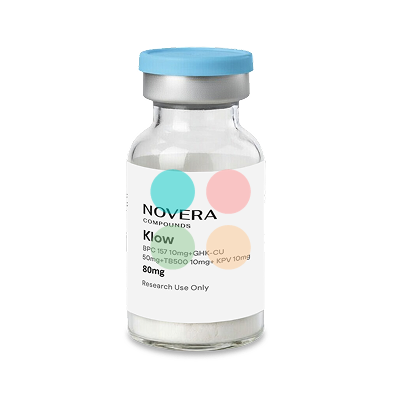
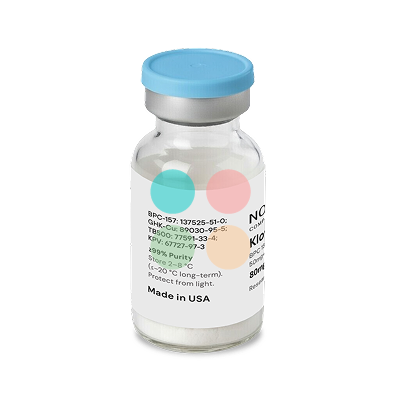
Klow Peptide Blend is a lyophilized four-peptide combination containing BPC-157, TB-500, GHK-Cu, and KPV, formulated for laboratory investigation of tissue repair, anti-inflammatory signaling, and extracellular matrix biology. KLOW contains four peptides in a standard 80 mg vial at a ratio of GHK-Cu 50 mg, BPC-157 10 mg, TB-500 10 mg, and KPV 10 mg – making it one of the most studied multi-component research models in contemporary peptide research.
This combined formulation is intended strictly for laboratory research use only and is supplied exclusively to qualified professionals. None of the individual components carry FDA approval for systemic therapeutic applications, and the blend is not approved for human consumption or human or veterinary use. Every claim presented below derives from animal studies, in vitro assays, or early-phase clinical work on individual peptides; no published study has yet evaluated the four-peptide combination together.
General Information About Klow Peptide Blend
KLOW Blend contains four distinct peptides, each contributing a different mechanism to the study of complex biological processes in controlled laboratory settings.
BPC-157 is a 15-amino-acid pentadecapeptide (sequence GEPPPGKPADDAGLV, molecular weight ~1,419.5 Da) originally isolated from human gastric juice. Its primary mechanism involves stimulation of angiogenesis through VEGFR2 activation and modulation of downstream ERK/Akt signaling pathways in endothelial cells. Plasma half-life after intravenous administration is approximately 15–30 minutes in animal models, though downstream tissue signaling may persist considerably longer.
TB-500 is a synthetic fragment of the full 43-amino-acid thymosin beta-4 protein. The fragment centers on the actin-binding motif LKKTET, which sequesters G-actin monomers and modulates cytoskeletal dynamics critical to cellular migration. Plasma half-life ranges from 2 to 4 hours depending on administration route, the longest of the four components.
GHK-Cu is a copper-binding peptide – the tripeptide Gly-His-Lys complexed with copper(II) – with a molecular weight of approximately 403 Da. This copper complex modulates gene expression governing collagen synthesis, elastin synthesis, matrix remodeling, and antioxidant defense. Its half-life in plasma is estimated at 1–2 hours. GHK-Cu is studied for copper-dependent signaling and gene regulation across numerous biological systems.
KPV (Lys-Pro-Val, MW ~342.44 Da) is the C-terminal anti-inflammatory tripeptide of alpha-melanocyte stimulating hormone. The mechanism involves direct inhibition of NF-κB/p65 nuclear import and suppression of MAPK (ERK/p38) cascades. KPV is included in KLOW but not in GLOW, the related three-peptide blend – a distinction reflecting the four-peptide preparation’s broader focus on immune-associated signaling pathways and inflammation control. KPV’s cellular uptake occurs via the PepT1 transporter (SLC15A1), with a Km of approximately 160 µM; notably, inflamed intestinal epithelial cells upregulate PepT1 expression, favoring selective delivery. Plasma half-life is roughly 1–2 hours.
KLOW Blend is supplied as an 80 mg lyophilized powder. Reconstituted solution stability is bounded by its least stable component, typically TB-500, which holds up for roughly 7 to 14 days at 2–8 °C. BPC-157 demonstrates longer stability (28–42 days under optimal conditions), while GHK-Cu and KPV remain moderately stable provided the copper coordination is maintained and repeated freeze-thaw cycles are avoided.
Klow Peptide Blend Use in the Research Setting
The blend is supplied as a lyophilized powder for reconstitution, designated for research and laboratory use only across controlled laboratory environments.
Tendon and Ligament Healing
Among the most active areas of tissue repair research for the klow blend peptide involves musculoskeletal connective tissue. BPC 157 and TB 500 have each demonstrated independent effects on collagen synthesis, blood vessel formation, and biomechanical recovery in animal models of tendon injury.
In a 2026 rat model published by Ozancan Biçer et al. in Joint Diseases and Related Surgery, daily intraperitoneal administration of TB-500 (60 µg/kg) or BPC-157 (10 µg/kg) for 4 weeks following Achilles tendon transection improved tendon histology and extracellular matrix maturation in ~330 g male Sprague-Dawley rats. The TB-500 group achieved a statistically significant increase in maximum load to failure versus controls (p < 0.05), with Bonar and Movin histology scores also significantly improved. When BPC 157 and TB 500 were administered together, architectural improvements were observed but did not surpass TB-500 alone for mechanical tensile strength – an important finding for researchers designing multi-component research models.
An earlier study by Staresinic et al. (2003), published in the Journal of Orthopaedic Research, demonstrated that BPC-157 administered at doses of 10 µg, 10 ng, or 10 pg/kg intraperitoneally after rat Achilles tendon transection improved Young’s modulus, load to failure, and Achilles functional index scores at days 4–14 compared with controls. Separate primary research on medial collateral ligament transection in rats showed that BPC-157 delivered intraperitoneally (10 µg or 10 ng/kg), topically (1 µg/g cream), or per-orally (~0.16 µg/ml in drinking water) for up to 90 days produced consistent functional, biomechanical, and histological improvements – evidence that the peptide’s structural repair effects generalize across connective tissue types and administration routes.
CITATION CAPSULE: In the 2026 Ozancan Biçer et al. study in Joint Diseases and Related Surgery, TB-500 administered at 60 µg/kg intraperitoneally for 4 weeks produced a statistically significant increase (p < 0.05) in maximum load to failure in transected rat Achilles tendons compared to untreated controls.
<em>Important to Know:</em>
Gastrointestinal Tissue Research
The klow blend combines two peptides with distinct but complementary gastrointestinal mechanisms. BPC-157’s gastroprotective effects – modulation of gastric mucosal integrity, antagonism of ulcer formation, and accelerated healing of rodent stomach lining lesions – stem from its native origin in human gastric juice. Meanwhile, the klow blend adds KPV as a potent suppressor of intestinal inflammatory responses via melanocortin-related peptides pathways.
Dalmasso et al. demonstrated in 2008, publishing in the Journal of Pharmacology and Experimental Therapeutics, that KPV at nanomolar concentrations (10 nM) inhibited IL-1β-induced NF-κB activation in Caco2-BBE intestinal epithelial cells by approximately 6-fold on a luciferase reporter assay. The tripeptide reduced IκB-α degradation, delayed phosphorylation kinetics, and suppressed IL-8 secretion. In murine models of DSS- and TNBS-induced colitis, oral KPV delivered in drinking water achieved roughly a 50% reduction in colon inflammation markers, with suppression of IL-1β, TNF-α, and IL-6 expression – data underscoring its relevance for tissue research on systemic inflammation cues.
“Nanomolar concentrations of KPV inhibit the activation of NF-κB and MAP kinase inflammatory signaling pathways, and reduce pro-inflammatory cytokine secretion … Oral administration of KPV reduces the incidence of DSS-, and TNBS-induced colitis indicated by a decrease in pro-inflammatory cytokine expression.” – Dalmasso et al., 2008
KPV uptake via the PepT1 transporter is particularly relevant because inflamed gut mucosa upregulates PepT1 expression, creating a selective delivery mechanism that concentrates the peptide precisely where inflammatory signaling is most active. KLOW is utilized in studies of chronic inflammation markers partly because of this targeted uptake phenomenon. For researchers, the formulation’s primary research focus includes immune-associated signaling that neither BPC-157 nor GHK-Cu address independently.
Skin and Wound Healing
Wound healing represents a convergence point where GHK-Cu, TB-500, and BPC-157 each contribute through distinct regenerative components: matrix synthesis, angiogenesis, and fibroblast recruitment.
GHK-Cu’s role in skin regeneration has advanced to human trials. A 2026 Phase 2 clinical trial (NCT07437586) is currently recruiting healthy adults to evaluate topical GHK-Cu gel (0.1% w/w) applied daily for 14 days to 5-mm punch-biopsy wounds. Primary endpoint is time to re-epithelialization over 21 days, with secondary outcomes including wound area reduction and scar quality at 12 weeks. Earlier preclinical work established that this copper-binding peptide upregulates genes for collagen, elastin, and antioxidant enzymes while promoting blood vessel formation and skin remodeling.
Full-length thymosin beta-4 – the parent molecule of TB-500 – was studied in 1999 by Malinda et al. in rat dermal wound models. Applying recombinant Tβ4 (~5 µg in 50 µL PBS) topically to 8-mm full-thickness punch wounds on days 0 and 2 produced visible macroscopic wound closure improvement by day 4, along with increased collagen deposition and vascularization compared to vehicle controls.
|
Study
|
Peptide(s) Tested
|
Model / Route
|
Key Outcome Data
|
|
Ozancan Biçer et al., 2026
|
TB-500 alone vs BPC-157 alone vs combination
|
IP, 60 µg/kg TB-500 and 10 µg/kg BPC-157, rat Achilles tendon, 4 weeks
|
TB-500: significantly higher maximum load to failure (p < 0.05); improved Bonar/Movin histology scores; combination did not exceed TB-500 alone in tensile strength
|
|
Dalmasso et al., 2008
|
KPV alone
|
10 nM in vitro (Caco2-BBE cells); oral in DSS/TNBS colitis mice
|
~50% reduction in colon inflammation markers; ~6-fold reduction in NF-κB-luciferase activity; suppression of IL-1β, TNF-α, IL-6
|
|
Malinda et al., 1999
|
Full-length thymosin β4
|
Topical, 5 µg/50 µL PBS, rat 8-mm punch wound
|
Accelerated wound closure visible by day 4; increased angiogenesis and collagen deposition vs control
|
|
GHK-Cu Phase 2 (NCT07437586), 2026
|
GHK-Cu 0.1% gel
|
Topical, human 5-mm punch biopsy, 14 days
|
Primary endpoint: re-epithelialization time over 21 days; secondary: wound area reduction, scar quality at 12 weeks (recruiting)
|
Anti-Inflammatory Signaling
KPV in KLOW enhances anti-inflammatory signaling pathways through a melanocortin receptor-independent mechanism, distinguishing it from full-length α-MSH. The multi-component mixture is used for anti-inflammatory research that GLOW, lacking KPV, does not address. The tripeptide directly blocks p65 nuclear translocation, preventing NF-κB-driven transcription of pro-inflammatory genes without requiring classical melanocortin receptor binding.
In vitro cellular data from Dalmasso et al. (2008) quantified the effect: 10 nM KPV applied to IL-1β-stimulated Caco2-BBE cells reduced NF-κB-luciferase activity approximately 6-fold, delayed IκB-α phosphorylation, and lowered IL-8 secretion. These results were obtained in intestinal epithelial cells, but the NF-κB pathway is broadly active across cell types including human bronchial epithelial cells and endothelial cells, extending potential research applications beyond gastrointestinal models.
CITATION CAPSULE: Dalmasso et al. reported in 2008 in the Journal of Pharmacology and Experimental Therapeutics that oral KPV in drinking water achieved approximately 50% reduction in colon inflammation markers in murine DSS- and TNBS-colitis models, with concomitant suppression of TNF-α, IL-1β, and IL-6 gene expression.
BPC-157 also contributes anti-inflammatory activity through a separate mechanism. In a rat supraspinatus tendon-to-bone model, BPC-157 decreased myeloperoxidase activity and reduced inflammatory cell influx during the acute phase (days 1–4), outperforming methylprednisolone on vascular index measures. TB-500 similarly reduces TNF-α, IL-6, and IL-1β levels in wound and tissue inflammation models, though human data remain limited to preclinical observations. Together, these individual components target overlapping but non-identical inflammation markers, which is why KLOW Blend is used for studying multi-pathway signaling interactions.
Cellular Migration and Cytoskeletal Dynamics
TB-500’s defining function in the blend centers on cytoskeletal dynamics. The LKKTET actin-binding sequence binds G-actin monomers, preventing premature polymerization and freeing actin for rapid reorganization at the leading edge of migrating cells. In vitro keratinocyte and fibroblast migration assays consistently demonstrate faster migration fronts with TB-500 relative to untreated controls – a property relevant to wound closure, systemic recovery from tissue injury, and skin regeneration research.
TB-500 is studied for its relationship to cell migration and actin dynamics across multiple tissue types. BPC-157 complements this through a different route: enhancing fibroblast proliferation and improving alignment of collagen fibrils at injury sites. In tendon healing models from Staresinic et al. (2003), BPC-157-treated tissues showed enlarged fibroblast populations with improved structural organization by day 14.
“In the first dermal study using 8 mm full-thickness punch wounds in rats, Tβ4 at 5 µg/50 µL … was found to accelerate wound closure, increase angiogenesis, and accelerate collagen deposition … Visible macroscopic improvement was seen in the treated group by day 4.” – Malinda et al., 1999
CITATION CAPSULE: TB-500 is examined for its effects on cellular communication and cell migration through its LKKTET actin-sequestering motif, which binds G-actin to modulate cytoskeletal reorganization; fibroblast and keratinocyte migration assays in vitro show accelerated migration front velocity relative to vehicle-treated controls.
KLOW focuses on broader signaling pathways than GLOW, and the inclusion of four distinct peptides – each engaging different cellular signaling cascades – reflects an approach designed for researchers studying how regenerative components interact within biological systems. No peer-reviewed study has yet tested combined administration of all four components in animal models or humans; interactions, additive or antagonistic effects, and combined pharmacokinetics remain uncharacterized.
Buy Klow Peptide Blend Online at FillerSupplies.com
Looking to order Klow Peptide online for your laboratory investigation? FillerSupplies.com carries the KLOW Blend as an 80 mg lyophilized vial, available for researchers who need a reliable source for this four-peptide combination. Whether you need a single vial or bulk quantities for extended protocols in tissue repair research, analytical testing, or anti-inflammatory signaling studies, FillerSupplies.com offers competitive pricing – contact the team directly regarding klow peptide 80mg price and volume discounts.
-
Authentic, certified products – original, quality-controlled compounds, warehouses worldwide.
-
11 years of reliability & trust – established supplier on the market since 2006.
-
Temperature-controlled shipping – thermal packaging with ice gel / cold packs preserves stability.
-
Express worldwide shipping – next-day dispatch, global delivery.
-
Best wholesale prices – tiered bulk discounts and price-match guarantee.
-
Privacy guaranteed; expert support at (888) 392-6640, WhatsApp and email, Mon-Fri 10am-6pm EST.
-
Supplied for research use only, to licensed professionals.
KLOW Blend is supplied exclusively for laboratory research use. Batch-specific Certificates of Analysis are important for verifying peptide purity, and researchers should confirm composition ratios (50:10:10:10 for GHK-Cu, BPC-157, TB-500, and KPV respectively) before initiating protocols. Purity for the four-peptide blend should be verified through High-Performance Liquid Chromatography. This product is not intended for human consumption and carries no FDA approval for injectable use.
FAQ
What Is Klow Peptide Blend and How Does It Work?
KLOW Blend contains four peptides - GHK-Cu, KPV, BPC-157, and TB-500 - each targeting different signaling pathways. GHK-Cu modulates extracellular matrix gene expression, KPV inhibits NF-κB-driven inflammatory signaling, BPC-157 stimulates angiogenesis through VEGFR2, and TB-500 promotes cellular migration via actin sequestration. KLOW Blend aids in understanding extracellular matrix biology, immune-associated signaling, and tissue repair across controlled laboratory settings.
How Much Klow Peptide Should I Take for Research Protocols?
KLOW peptide blends are designated for laboratory research use only and not for human consumption. Reconstitute KLOW with 3.0 mL of bacteriostatic water. Common dosing in published community research protocols ranges from 250 to 750 mcg per component daily via subcutaneous administration in animal models, with typical cycle lengths of 4–6 weeks on and 2–4 weeks off, though these parameters are not validated by peer-reviewed human trials.
Where Can I Buy Klow Peptide in the USA?
Researchers asking about klow peptide where to buy USA can order directly from FillerSupplies.com, which offers express domestic and international shipping with temperature-controlled packaging. KLOW peptides are often sold by online research vendors for laboratory research use only. High-quality vendors provide COAs verified by independent analytical labs, and FillerSupplies.com has served qualified professionals since 2006.
What Is the Klow Peptide 80mg Price?
The standard KLOW vial contains 80 mg total blend. Pricing varies based on order volume - FillerSupplies.com offers tiered bulk discounts and a price-match guarantee. Contact the support team at (888) 392-6640 or via WhatsApp for current pricing and availability.
How Should Klow Peptide Be Stored and Reconstituted?
Store reconstituted KLOW at 2–8°C and protect from light. KLOW peptide blends require proper handling and storage before reconstitution - keep lyophilized vials sealed in a cool, dry environment. Once reconstituted, use within 7–14 days; TB-500 is the stability-limiting component. Avoid repeated freeze-thaw cycles, which degrade peptide integrity.
Is Klow Peptide Different from BPC-157 Alone?
Substantially. Where BPC-157 acts primarily through VEGFR2-mediated angiogenesis and gastroprotection, the KLOW blend combines four individual peptides spanning matrix synthesis (GHK-Cu), anti-inflammatory signaling (KPV), cytoskeletal dynamics (TB-500), and tissue repair (BPC-157). KLOW is investigated for its role in tissue repair studies requiring multi-pathway analysis that individual peptides cannot address independently.
Are Klow Peptide Components WADA-Prohibited Substances?
Yes. TB-500, as a fragment of thymosin beta-4, falls under WADA category S2 (growth factors) and is banned at all times. BPC-157 is classified under WADA category S0 (non-approved substances) for systemic use. Any preparation containing these compounds is prohibited for competitive athletes. Researchers studying melanocortin-related peptides (KPV) and GHK-Cu face fewer regulatory restrictions, but the complete blend remains non-compliant for sport.