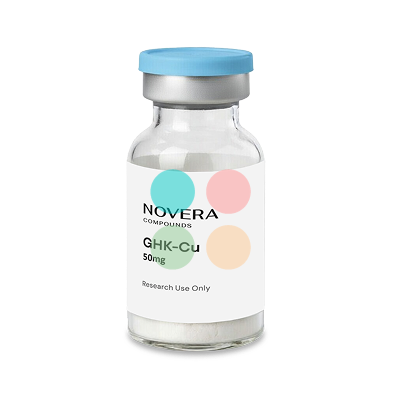
GHK-Cu is a copper-bound tripeptide-glycyl-L-histidyl-L-lysine chelated to a single Cu²⁺ ion-extensively studied for its role in tissue repair, collagen production, wound healing, and regenerative biology. First isolated in 1973 by Loren Pickart from human albumin fractions, this naturally occurring peptide found in blood plasma has since become one of the most investigated copper peptides in preclinical research, with findings that suggest broad implications for skin remodeling, inflammation reduction, and even central nervous system function.
This GHK-Cu peptide is supplied by FillerSupplies.com under the Novera brand exclusively for research and laboratory use by licensed professionals. It is not intended to diagnose, treat, cure, or prevent disease in humans, and it is not FDA-approved as a drug or therapeutic agent. Researchers seeking to buy GHK-Cu for laboratory studies will find comprehensive product and scientific details below.
General Information About GHK-Cu
GHK-Cu is a tripeptide composed of three amino acids-glycine, histidine, and lysine-bound to a copper(II) ion via the histidine imidazole nitrogen and the glycine N-terminus. Its molecular formula is approximately C₁₄H₂₂CuN₆O₄, with a molecular weight of roughly 401.9 g/mol and a copper content of about 15.8% by weight. In its copper-bound form, the peptide exhibits biological activity that the free apopeptide (GHK without copper) largely cannot replicate, noting that the copper ion is critical for the compound’s regenerative and redox-active properties.
GHK-Cu occurs naturally in human plasma at a concentration of approximately 200 ng/mL in young healthy adults. This level declines to roughly 80 ng/mL by age 60, a reduction that correlates with diminished regenerative capacity and accelerated aging at the tissue level. The peptide is also detected in saliva and urine.
The mechanism of action spans multiple biological pathways. GHK-Cu enhances collagen synthesis (types I and III), upregulates glycosaminoglycan (GAG) production, and modulates the balance between matrix metalloproteinases (MMPs) and their tissue inhibitors (TIMPs)-thereby both promoting extracellular matrix (ECM) formation and controlling ECM degradation. It stimulates angiogenesis by forming new blood vessels, attracts nerve and immune cells to injury sites, and exerts antioxidant and anti-inflammatory effects including the reduction of inflammatory cytokines. Estimated plasma half-life is approximately 2 hours, though precise human pharmacokinetic data remain limited and are largely extrapolated from animal and in vitro systems.
GHK-Cu Use in the Research Setting
GHK-Cu is supplied as a lyophilized powder for reconstitution in the laboratory, intended for research and laboratory use only. Below are the primary areas of active investigation, supported by preclinical and early clinical evidence.
#1. Wound Healing and Tissue Remodeling
GHK-Cu may accelerate wound healing by 33%, based on preclinical wound chamber models in which the peptide produced concentration-dependent increases in dry weight, total protein, collagen, DNA, and glycosaminoglycan content. Collagen synthesis was increased roughly twice as much as non-collagen protein in these models. GHK-Cu may promote tissue remodeling and faster wound healing through its dual action on ECM synthesis and controlled degradation via MMP/TIMP regulation. A peptide-incorporated collagen dressing containing GHK increased collagen accumulation by approximately 9-fold in certain wound types in healthy rats.
GHK-Cu is regarded for tightening loose skin and healing wounds or scars in research contexts. Injectable forms of GHK-Cu are used experimentally for systemic repair, though injectable GHK-Cu is not FDA-approved and carries potential risks. Topical GHK-Cu is often recommended in the literature due to better evidence than injections.
Research models consistently demonstrate that GHK-Cu promotes tissue remodeling and healing after skin procedures, with collagen synthesis rates exceeding non-collagen protein production by a factor of two.
#2. Anti-Aging, Skin Texture, and Collagen Production
GHK-Cu offers significant anti-aging benefits by stimulating collagen production and elastin synthesis, improving skin density and elasticity in research models. In human cosmetic trials, a GHK-Cu nano-lipid carrier applied twice daily for 8 weeks reduced wrinkle volume by approximately 55.8% versus a control serum and approximately 31.6% versus Matrixyl 3000, while wrinkle depth dropped roughly 32.8%. GHK-Cu may improve skin hydration and texture, and it fades hyperpigmentation and reduces redness based on published trial data.
GHK-Cu increases collagen and elastin synthesis, improving skin density-a property that makes it valuable in research on aging, skin elasticity, and the reduction in the appearance of wrinkles. It can enhance collagen synthesis in skin cells at low nanomolar concentrations (1–10 nM) in human dermal fibroblast cultures.
Choose GHK-Cu serums for lightweight skincare applications in formulation research, while GHK-Cu creams are best for hydration and larger skin areas in topical studies. Researchers should note that layering GHK-Cu with strong vitamin C or retinol in combination formulations may alter peptide stability. A patch test is recommended before using GHK-Cu products in any topical application study, as some users may experience skin sensitivity or irritation, and redness and dryness can occur with topical GHK-Cu use.
#3. Anti-Inflammatory and Antioxidant Pathways
GHK-Cu may reduce inflammation by lowering TNF-alpha levels, and it has demonstrated anti-inflammatory effects in both skin fibroblast cultures and animal wound models. It reduces inflammation and improves skin elasticity in preclinical studies. GHK-Cu has antioxidant properties that combat oxidative stress, and it protects cells from UV radiation damage and reduces oxidative stress-properties with broad implications for research into tissue damage, photoaging, and chronic inflammation.
In rabbit wound models, GHK-Cu increased antioxidant enzyme activity, offering a pathway to protect against free radical-mediated injury. The difference between GHK-Cu and the apopeptide GHK (without copper) is especially pronounced in antioxidant and redox activity, as copper delivery is essential for copper-dependent enzymatic functions.
#4. Hair and Scalp Research
GHK-Cu contributes to scalp health and hair follicle function, and it may help increase follicle size and stimulate hair growth in preclinical models. Topical GHK-Cu products are common for skin and hair research, and some investigators explore the peptide’s role in promoting healthier looking hair through follicle-level regeneration. While GHK-Cu has a deeper evidence base in skin and wound biology, its copper peptide cousin AHK-Cu (Ala-His-Lys + Cu²⁺) has thinner literature more focused on hair biology. No high-powered head-to-head RCT confirms one as superior in this category.
#5. Neuroprotection and Central Nervous System Studies
GHK-Cu treatment improved cognitive function in Alzheimer’s mice models, positioning it as a compound of interest in brain and central nervous system research. While systemic research in humans remains extremely limited, preclinical work in mice suggests a pathway through which GHK-Cu may alter neurodegenerative processes. This is an active and beginning area of investigation, and the implications for human disease remain speculative pending controlled clinical trials.
<em>Important to Know:</em>
| Feature |
GHK-Cu (Gly-His-Lys + Cu²⁺) |
AHK-Cu (Ala-His-Lys + Cu²⁺) |
Apopeptide GHK (No Copper) |
| Amino Acid Sequence |
Gly-His-Lys |
Ala-His-Lys |
Gly-His-Lys |
| Copper Present |
Yes (Cu²⁺ bound) |
Yes (Cu²⁺ bound) |
No |
| Molecular Weight |
~401.9 g/mol |
~415.9 g/mol |
~340.4 g/mol |
| Evidence Base |
Extensive: wound healing, collagen, aging, gene modulation, angiogenesis |
Thinner: primarily hair/follicle focused |
Partial; lacks copper-dependent actions |
| Effective In Vitro Concentration |
1–10 nM in fibroblast models |
Similar order (limited studies) |
Requires copper binding to match activity |
| Primary Research Applications |
Skin, wound, inflammation, neuro, beauty, scalp |
Hair biology, follicle cycling |
Comparison/control in copper peptide studies |
GHK-Cu may increase wound healing by 33% and reduce wrinkle volume by approximately 55.8% versus control in published studies-making it one of the most quantitatively validated copper peptides in preclinical and early clinical research.
Topical GHK-Cu generally has a good safety profile when used as directed. Avoid applying GHK-Cu to broken or irritated skin. GHK-Cu products should show clear product form and directions for reconstitution and laboratory handling. Look for GHK-Cu products with third-party lab testing, and GHK-Cu products should provide access to Certificates of Analysis to verify quality, identity, and copper concentration.
Product Specifications
- Form: Lyophilized powder (dry, blue crystalline appearance)
- Peptide Sequence: Gly-His-Lys (GHK), copper-bound form
- Molecular Weight: ~401.9 g/mol
- Copper Content: ~15.8% by weight
- Shelf Life: Approximately 2 years under recommended storage
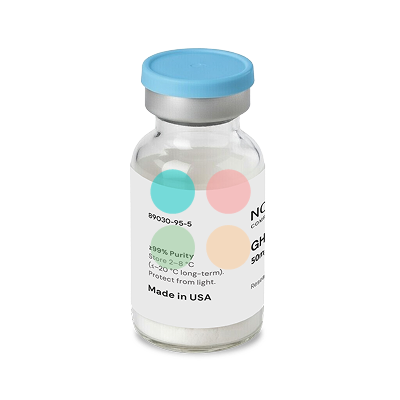
- Storage: Sealed, dark, cold, dry location; recommended temperature –20 °C to 8 °C
- Handling: Avoid heat, moisture, and light; once reconstituted, use promptly or follow supplier directions
- Documentation: Certificate of Analysis matched to lot number
- Packaging: Lyophilized powder in sealed vials; cold-chain shipping to preserve stability
- Intended Use: Research and laboratory use only
The 50mg Presentation of GHK-Cu
This listing supplies GHK-Cu as a 50mg vial; the same compound is also offered in 100mg. The peptide is identical across strengths, so the choice is about how much material a protocol needs from one lot rather than about the molecule itself.
Working concentration follows directly from the diluent volume. Reconstituting a 50mg vial with 2mL of bacteriostatic water yields 25mg/mL, while 4mL yields 12.5mg/mL. Because concentration depends on both fill and diluent, research protocols document the reconstitution recipe rather than the vial size alone, which is what makes results comparable between strengths.
A 50mg fill matches shorter skin-regeneration and collagen-synthesis experiments, where the larger vial would exceed what one protocol uses inside the in-use window of a reconstituted solution. Once reconstituted, the solution is refrigerated, protected from light and used within the planned experimental window, regardless of which fill it was prepared from.
Who Should Buy This GHK-Cu
Ideal for:
- Licensed researchers studying tissue repair, wound healing, and regenerative pathways
- University laboratories investigating copper peptide biology, collagen synthesis, and ECM dynamics
- Research institutions examining anti-inflammatory, antioxidant, or neuroprotective mechanisms
- Formulation scientists developing and evaluating topical delivery systems (serum, cream, lotion, toner) for preclinical review
If your research requires an active, well-characterized ghk cu copper peptide with an extensive evidence base, this product is designed to match your laboratory needs. This GHK-Cu is supplied for research and laboratory use only and is not intended for human therapeutic or cosmetic application outside of controlled study settings.
Related research peptides available at FillerSupplies.com: BPC-157, TB-500, KPV.
FAQ
How Does the 50mg GHK-Cu Vial Differ from the 100mg?
The peptide itself is identical; only the quantity of lyophilized powder differs. A 50mg vial yields more material per unit, which changes how many working solutions can be prepared from a single lot rather than changing the compound.
How Is a 50mg Vial of GHK-Cu Reconstituted?
Final concentration follows directly from the diluent volume: adding 2mL of bacteriostatic water to a 50mg vial gives 25mg/mL, and 4mL gives 12.5mg/mL. The diluent is directed down the vial wall and the vial swirled, never shaken.
Why Would a Laboratory Choose the 50mg Strength?
The smaller fill fits shorter dermal and wound-healing experiments, where the larger vial would exceed what a single protocol consumes.
Does the 50mg Fill Affect Stability?
No. Fill quantity does not alter the stability of the lyophilized powder. Stability matters after reconstitution, when the solution is refrigerated and used inside the planned experimental window.
How Should Reconstituted GHK-Cu Be Stored?
Refrigerate at 2-8 degrees C and protect from light. Repeated freeze-thaw cycles are avoided because they degrade peptide integrity and introduce variability between runs.
Can Different GHK-Cu Strengths Be Used Interchangeably in a Study?
Only if the final working concentration is matched. Because concentration depends on both fill quantity and diluent volume, protocols document the reconstitution recipe rather than the vial size alone.
Is GHK-Cu Approved for Human Use?
No. It holds no FDA approval for any indication and is supplied strictly for laboratory research by licensed professionals.
- Pickart, L., Vasquez-Soltero, J. M., & Margolina, A. (2015). GHK Peptide as a Natural Modulator of Multiple Cellular Pathways in Skin Regeneration. BioMed Research International, 2015, 648108. https://doi.org/10.1155/2015/648108
- Arul, V., Kartha, R., & Jayakumar, R. (2007). A therapeutic approach for diabetic wound healing using biotinylated GHK incorporated collagen matrices. Life Sciences, 80(4), 275-284. https://doi.org/10.1016/j.lfs.2006.09.018
- Maquart, F. X., et al. (1988). Stimulation of collagen synthesis in fibroblast cultures by the tripeptide-copper complex glycyl-L-histidyl-L-lysine-Cu2+. FEBS Letters, 238(2), 343-346. https://doi.org/10.1016/0014-5793(88)80509-X