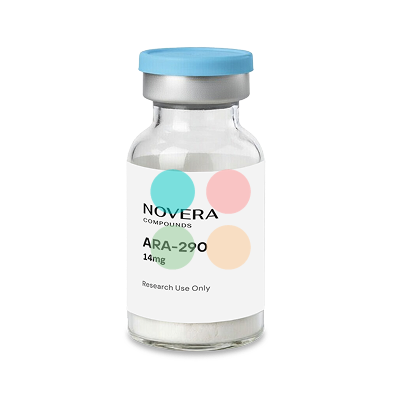
ARA-290 is a synthetic 11-amino-acid peptide derived from erythropoietin (EPO) that selectively activates the innate repair receptor (IRR) without stimulating red blood cell production. As a nonerythropoietic peptide engineered from the helix B surface domain of EPO, this compound has been studied for conditions like diabetic neuropathy and small-fiber nerve loss, tissue protection following ischemia-reperfusion injury, and immune modulation in autoimmune experimental models. Licensed researchers looking for ara-290 peptide for sale will find it available in lyophilized form for laboratory investigation of its tissue repair mechanisms, anti inflammatory properties, and neuroprotective signaling pathways.
FillerSupplies.com supplies ARA-290 as a research-grade compound intended exclusively for laboratory and investigational use. ARA-290 is not FDA-approved for therapeutic use, and no commercial new drug application exists for it, as Araim Pharmaceuticals has closed operations. Clinical trials evaluating ARA-290 have been incomplete and remain in early phases; Phase II clinical trials have been completed, but Phase III studies are needed for approval. Every vial ships with documentation verifying identity and composition, and research vendors must explicitly state that ARA-290 is not for human use. There are legal and health risks associated with the self-administration of ARA-290.
General Information About ARA-290
ARA-290 (also known as cibinetide or pHBSP) is a synthetic peptide consisting of 11 amino acids with the sequence Pyr-Glu-Gln-Leu-Glu-Arg-Ala-Leu-Asn-Ser-Ser. The “Pyr” denotes pyroglutamic acid, formed by spontaneous cyclization of the N-terminal glutamine residue. Its molecular weight is approximately 1,257 Da. The peptide lacks cysteine, methionine, and tryptophan residues, which reduces susceptibility to oxidative degradation during storage and handling.
This erythropoietin derived peptide originates from the helix B surface domain of the EPO molecule. Full-length erythropoietin (EPO) binds two distinct receptor complexes: the classical EPO receptor homodimer (responsible for erythropoiesis) and the tissue protective receptor, a heteromer of the EPO receptor and the β common receptor (βcR/CD131), also called the innate repair receptor IRR. ARA-290 is designed to target the innate repair receptor selectively. It binds to the EPOR-βcR complex to inhibit inflammation and promote cell survival, while producing no measurable hematopoietic effects. The compound does not increase red blood cell counts, platelet counts, or thrombotic risk, distinguishing it from recombinant EPO at tissue-protective doses.
ARA-290’s mechanism of action centers on activation of the innate repair receptor. Binding triggers downstream anti-apoptotic, anti inflammatory, and reparative signaling cascades. These include suppression of proinflammatory cytokines (IL-6, TNF-α, IL-1β, IL-12), reduction of microglia activation in neural tissue, and promotion of tissue regeneration pathways. Brines and Cerami described this unique mechanism in detail in their review published in the Journal of Molecular Medicine, noting that IRR activation leads to lasting gene-expression changes that persist well beyond the peptide’s plasma half-life.
Pharmacokinetic data from human volunteer studies show that subcutaneous administration of 4 mg ARA-290 produces peak plasma concentrations of approximately 3 ng/mL (≈2.4 nmol/L), with a terminal half-life of around 20 minutes. Intravenous dosing clears faster, with a half-life near 2 minutes. Despite such rapid clearance, biological effects on tissue repair and cytokine modulation persist for hours to days because IRR activation initiates self-sustaining intracellular signaling.
Research peptides are typically supplied as lyophilized powders for stability. ARA-290 arrives as a white to off-white lyophilized powder. Long-term storage requires freezing at −20 °C, with protection from light and moisture. Once reconstituted in sterile water or bacteriostatic water at neutral pH, the solution should remain refrigerated and used within a limited window. Multiple freeze-thaw cycles degrade peptide activity. A Certificate of Analysis must verify identity and purity of ARA-290 before use in any experimental protocol.
ARA-290 Use in the Research Setting
ARA-290 is supplied as a lyophilized powder for research and laboratory use only. Below, five areas of active investigation illustrate the peptide’s potential across neuropathic pain, tissue protection and repair, immunomodulation, metabolic research, and neurological studies.
Neuropathic Pain Research
Relief of pathophysiological pain is one of the most extensively documented effects of ARA-290 in experimental models. In a 2014 rat spared nerve injury (SNI) study by Brines et al. published in Experimental Neurology, intraperitoneal doses of 3–60 µg/kg administered on days 1, 3, 6, 8, and 10 post-surgery produced dose-dependent relief of both mechanical and cold allodynia lasting up to 15 weeks. Wild-type mice responded, while βcR knockout mice showed no benefit, confirming that pain reduction depends on innate repair receptor signaling.
ARA-290 has shown a 40% average pain reduction in clinical trials involving neuropathic symptoms. The compound may increase the threshold of TRPV1 channels, a mechanism explored through calcium imaging of dorsal root ganglion and trigeminal ganglion neurons. This contrasts with traditional analgesic compounds that act on opioid receptors or sodium channels; ARA-290 instead modulates the inflammatory cytokine profile at the injury site, reducing pro inflammatory cytokines that sensitize nociceptors.
A 2014 phase 2 trial led by Brines and colleagues, published in Molecular Medicine enrolled type 2 diabetes patients with neuropathic pain. Subjects self-injected 4 mg subcutaneously daily for 28 days. ARA-290 improved neuropathic symptom questionnaire scores (PainDetect, SFNSL) compared to placebo. In sarcoidosis patients with small fiber neuropathy, a separate trial using 2 mg IV three times weekly for 4 weeks showed responder rates (≥15-point SFNSL reduction) of 42% in the treated arm versus 0% in the placebo arm.
In 2014, Brines and colleagues reported in Molecular Medicine that 28 days of subcutaneous ARA-290 at 4 mg/day increased corneal nerve fiber density in type 2 diabetes patients whose baseline density fell more than 1 SD below normal, alongside reductions in HbA1c and neuropathic symptom scores.
Important to Know: All neuropathic pain data derive from controlled research settings; this non erythropoietic peptide is sold strictly as a research compound by chemical suppliers and carries no approved therapeutic indication.
Tissue Protection and Repair Studies
ARA-290 prevents damage from ischemia-reperfusion injury in multiple organ systems studied preclinically. In kidney ischemia-reperfusion models, post-reperfusion administration improved glomerular filtration rate within 7 days, reduced fibrosis markers (TGF-β, α-SMA), and lowered acute inflammation without thrombotic or cardiovascular adverse events (Brines et al., Molecular Medicine, 2012).
The compound inhibits pro-inflammatory cytokines like IL-6 and TNF-α, and ARA-290 reduces pro-inflammatory cytokines like IL-1β and TNF-α across tissue types. It also significantly inhibited macrophage-mediated inflammation in renal and cutaneous models. ARA-290 may enhance tissue repair and reduce scar formation through these combined anti inflammatory and regenerative pathways.
Wound healing research provides some of the clearest quantitative evidence for tissue regeneration. In a rat cutaneous injury model published in Molecular Medicine (Brines et al., 2008), daily subcutaneous injection of 1 nmol/kg ARA-290 accelerated wound closure: by day 7, wounds in the treated group were approximately 84% healed versus 63% in control solution groups.
|
Parameter
|
ARA-290
|
Full-Length EPO
|
|
Target Receptor
|
Innate repair receptor (EPOR-βcR heteromer)
|
EPOR homodimer + EPOR-βcR heteromer
|
|
Red Blood Cell Production
|
None observed
|
Primary function; stimulates erythropoiesis
|
|
Thrombotic Risk
|
Not detected in preclinical or Phase II studies
|
Increased at tissue-protective doses
|
|
Wound Closure (Rat, Day 7)
|
~84% healed
|
~63–67% healed at molar-equivalent dose
|
|
Molecular Weight
|
~1,257 Da (11 amino acids)
|
~30,400 Da (165 amino acids)
|
|
Plasma Half-Life (SC, Human)
|
~20 minutes
|
~6–8 hours
|
Immunomodulation Research
TPR activation by ARA-290 may lead to macrophage inactivation. The peptide inhibits macrophage activation in multiple tissue environments and can enhance macrophage phagocytosis of apoptotic cells, facilitating resolution of inflammation rather than chronic immune response. ARA-290 may also modulate antigen presentation by dendritic cells, influencing adaptive immunity pathways downstream.
Transplantation research has examined ARA-290 for graft protection. Preclinical studies on transplanted islets showed that the compound reduced cytokine induced damage and improved graft survival in murine models. In a 2014 study published in PLoS ONE, treatment of rat experimental autoimmune neuritis (EAN) with 30 mg/kg/day of ARA-290 from days 7 to 21 suppressed Th1 responses, increased regulatory T cells, and enhanced remyelination. ARA-290 is being studied for its role in autoimmune conditions where fine tuning of the immune system balance between pro-inflammatory and regulatory pathways could alter disease progression.
ARA-290 activates the EPOR-βcR complex without triggering erythropoiesis, enabling researchers to study immune modulation and tissue protective signaling independently from the hematopoietic effects that confound EPO-based experiments.
Metabolic and Endothelial Studies
Pancreatic islet protection is a compelling area of metabolic research. ARA-290 protects pancreatic islets from cytokine-induced damage in vitro; cultured islets exposed to IL-1β and TNF-α showed improved viability when treated with the peptide compared to control solution. ARA-290 improves metabolic control in type 2 diabetes models: the Brines et al. 2014 phase 2 trial documented modest but statistically meaningful HbA1c reductions and improved lipid profiles after 28 days of subcutaneous dosing.
Endothelial colony forming cells (ECFCs) represent another active research area. ARA-290 enhances cell survival under oxidative stress conditions in ECFC cultures, and ECFC transplantation studies suggest the compound’s vasoreparative potential may extend to blood vessels damaged by diabetic microangiopathy. Retinal ischemia research has explored the peptide in oxygen induced retinopathy (OIR) models. In OIR mice, ARA-290 reduced neovascularization and inflammatory markers in the vitreous humor, and analysis of the ischemic retina showed decreased microglia activation compared to untreated animals.
Neurological Research Applications
CNS neuroprotection studies have examined ARA-290 in stroke and neurodegenerative models. As a nonhematopoietic erythropoietin analogue, the compound provides tissue protection to neural cells without the polycythemia risk that limits high-dose EPO use in brain injury research. ARA-290 may enhance axonal regeneration in nerve injuries: the corneal nerve fiber density data from diabetic neuropathy trials support this finding in a clinical context, and preclinical nerve crush models have demonstrated accelerated fiber regrowth.
Cognitive function research remains at an earlier stage. Murine models of neuroinflammation show that ARA-290 suppresses activated macrophages and microglia activation in hippocampal tissue, which correlates with preserved spatial memory performance. However, these findings derive from animal studies only, and therapeutic applications in human neurodegenerative disease remain speculative without Phase III data.
Important to Know: ARA-290 falls under WADA Prohibited List category S2.1.5 (“innate repair receptor agonists”) because of its mechanism of action as an erythropoietin derived peptide targeting the EPO receptor pathway. Researchers working with athletic populations or sports-related protocols should be aware that the compound is presumed prohibited even though it is not explicitly named on the list.
Buy ARA-290 Online at FillerSupplies.com
Researchers ready to buy ARA-290 for laboratory investigation can source certified, research-grade cibinetide through FillerSupplies.com. Careful vetting of suppliers is essential when sourcing ARA-290 materials, as some vendors selling ARA-290 may lack quality control and regulatory oversight. FillerSupplies.com provides authenticated product accompanied by documentation of identity and composition, shipped under conditions that preserve peptide stability from warehouse to bench. The ara 290 peptide price reflects competitive wholesale positioning with volume-based savings for institutional buyers.
-
Authentic, certified products; original, quality-controlled compounds, warehouses worldwide.
-
11 years of reliability & trust; established supplier on the market since 2006.
-
Temperature-controlled shipping; thermal packaging with ice gel / cold packs preserves stability.
-
Express worldwide shipping; next-day dispatch, global delivery.
-
Best wholesale prices; tiered bulk discounts and price-match guarantee.
-
Privacy guaranteed; expert support at (888) 392-6640, WhatsApp and email, Mon-Fri 10am-6pm EST.
-
Supplied for research use only, to licensed professionals.
ARA-290 is sold strictly as a research compound by chemical suppliers. All orders are fulfilled exclusively for licensed researchers and institutions conducting approved laboratory investigations. Add products in the cart and proceed through secure checkout for fast dispatch.
Related research peptides available at FillerSupplies.com: BDNF, Semax, Selank.
FAQ
What Is ARA-290 and How Does It Work?
ARA-290 is a synthetic 11-amino-acid peptide derived from erythropoietin that selectively binds the innate repair receptor (EPOR-βcR heteromer). By activating this tissue protective receptor, the compound triggers anti-apoptotic and anti inflammatory signaling cascades without stimulating red blood cell production or the classical EPO receptor homodimer involved in erythropoiesis.
Is ARA-290 Safe for Research Applications?
Phase II clinical trials reported no serious adverse events in laboratory parameters (hematology, liver, kidney, electrolytes) at doses up to 4 mg/day subcutaneously over 28 days. Animal toxicology across mice, rats, and rabbits showed no hematopoietic stimulation or cardiovascular toxicity even at very high doses. ARA-290 is not FDA-approved for therapeutic use, and clinical trials remain in early phases.
How Does ARA-290 Compare to Erythropoietin?
Full-length EPO (molecular weight ~30,400 Da) binds both the EPOR homodimer and the EPOR-βcR heteromer, stimulating erythropoiesis and carrying thrombotic risk at tissue-protective doses. ARA-290 (~1,257 Da) activates only the innate repair receptor, producing tissue protection without hematopoietic effects. In wound healing models, ARA-290 at 1 nmol/kg achieved ~84% wound closure by day 7, outperforming molar-equivalent EPO at ~63%.
What Are Typical Research Dosing Ranges for ARA-290?
Rat neuropathic pain models use 3–60 µg/kg intraperitoneally; wound healing models use 1 nmol/kg subcutaneously daily; autoimmune neuritis models use 30 mg/kg/day. Human Phase II trials administered 4 mg subcutaneously daily or 2 mg intravenously three times per week. These figures are provided for research reference only and do not constitute dosing recommendations.
How Should ARA-290 Be Stored and Reconstituted?
Store lyophilized powder at −20 °C long-term, protected from light and moisture. Reconstitute with sterile water, bacteriostatic water, or PBS at neutral pH. Refrigerate reconstituted solution at 2–8 °C and use within the stability window indicated on the Certificate of Analysis. Avoid foaming during mixing and do not subject reconstituted material to multiple freeze-thaw cycles.
Is ARA-290 a Prohibited Substance in Sports?
ARA-290 is presumed prohibited under WADA Prohibited List category S2.1.5, which covers innate repair receptor agonists including EPO-derived non hematopoietic erythropoietin mimetic compounds. Although the molecule is not named explicitly, its mechanism of action places it within the prohibited class. Researchers conducting sports-related studies should treat it accordingly.
Where Can I Buy ARA-290 for Research?
Licensed researchers can buy ara 290 peptide through FillerSupplies.com, which ships temperature-controlled, authenticated research-grade cibinetide worldwide. Purity of ARA-290 should generally be ≥99% as verified by High-Performance Liquid Chromatography, and each lot ships with identity documentation. ARA-290 is available only through clinical trials and expanded access for therapeutic contexts; for laboratory research, FillerSupplies.com offers express dispatch.
- Brines, M., et al. (2008). Nonerythropoietic, tissue-protective peptides derived from the tertiary structure of erythropoietin. Proceedings of the National Academy of Sciences, 105(31), 10925–10930. DOI: 10.1073/pnas.0805594105
- Brines, M., Dunne, A. N., van Velzen, M., et al. (2014). ARA 290, a nonerythropoietic peptide engineered from erythropoietin, improves metabolic control and neuropathic symptoms in patients with type 2 diabetes. Molecular Medicine, 20(1), 658–666. DOI: 10.2119/molmed.2014.00215
- Brines, M., & Cerami, A. (2012). The receptor that tames the innate immune response. Molecular Medicine, 18(1), 486–496. DOI: 10.2119/molmed.2011.00414
- Dahan, A., et al. (2013). ARA 290 improves symptoms in patients with sarcoidosis-associated small nerve fiber loss and increases corneal nerve fiber density. Molecular Medicine, 19(1), 334–345. DOI: 10.2119/molmed.2013.00122
- Liu, Y., Luo, B., Han, F., et al. (2014). Erythropoietin-derived nonerythropoietic peptide ameliorates experimental autoimmune neuritis by inflammation suppression and tissue protection. PLoS ONE, 9(3), e90942. https://doi.org/10.1371/journal.pone.0090942