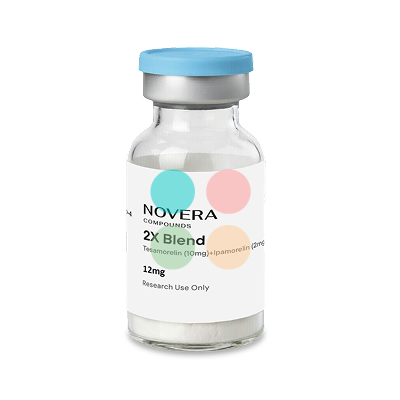
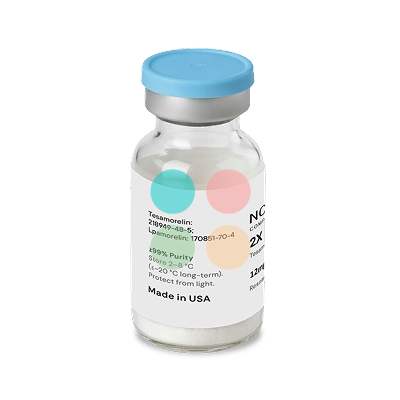
The 2X Blend combines tesamorelin, a synthetic growth hormone releasing hormone analogue, with ipamorelin, a selective growth hormone secretagogue, into a single formulation studied for its capacity to stimulate enhanced growth hormone production through two distinct receptor pathways. Combining tesamorelin and ipamorelin creates dual receptor synergy for growth hormone stimulation-tesamorelin acts on GHRH receptors in the pituitary gland while ipamorelin selectively activates growth hormone secretagogue receptors in the hypothalamus. Researchers investigating the growth hormone axis, visceral fat reduction, metabolic function, and body composition changes have turned to this pairing as a tool for probing how complementary mechanisms at the anterior pituitary gland may yield greater GH release than either peptide alone.
This ipamorelin peptide blend is supplied as a lyophilized powder strictly for research and laboratory use by licensed professionals. Neither component of the blend is approved for general human consumption as a combination product, and all findings discussed below derive from studies of individual peptides or mechanistic inference from related growth hormone releasing peptide research. The two-peptide preparation stimulates endogenous growth hormone release through pathways that remain under active investigation in pharmaceutical research settings worldwide.
General Information About 2X Blend (Tesamorelin + Ipamorelin)
Tesamorelin is a 44-amino-acid hormone analogue of endogenous GHRH, with a trans-3-hexenoic acid (hexenoyl) moiety attached at its N-terminus to confer resistance to enzymatic degradation by dipeptidyl aminopeptidase. Its molecular formula is C₂₂₁H₃₆₆N₇₂O₆₇S, and the free base molecular weight sits at approximately 5,136 Da. Tesamorelin mimics GHRH to stimulate endogenous growth hormone release by engaging the GHRH receptor-a Gs-protein coupled receptor on somatotroph cells that activates the cAMP/PKA signaling cascade. Tesamorelin has FDA approval for treating excess abdominal fat in HIV-associated lipodystrophy, where it is administered at 2 mg subcutaneously once daily. Published pharmacokinetic data suggest a subcutaneous half-life on the order of approximately 26 minutes, though the downstream GH secretory effects persist considerably longer.
Ipamorelin is a pentapeptide with the sequence Aib-His-D-2-Nal-D-Phe-Lys-NH₂ and a free base molecular weight of roughly 711.9 Da (molecular formula C₃₈H₄₉N₉O₅). As a ghrelin mimetic, it binds selectively to the GHS-R1a (ghrelin receptors), triggering the Gq/PLC/IP₃/Ca²⁺ pathway in pituitary somatotrophs. Gobburu and colleagues reported in a 1999 pharmacokinetic-pharmacodynamic modelling study in human volunteers that ipamorelin displays a terminal half-life of approximately 2 hours, a volume of distribution of ~0.22 L/kg, and a time to peak GH release of roughly 0.67 hours after subcutaneous administration. Ipamorelin selectively stimulates growth hormone release without cortisol spikes-unlike many other GH secretagogues, it does not significantly raise ACTH, cortisol, or prolactin at research-relevant concentrations.
Dual pathway stimulation yields a stronger growth hormone pulse than each peptide alone. The mechanistic rationale is well-established: GHRH receptor agonism (cAMP/PKA) and GHS-R1a activation (PLC/IP₃/Ca²⁺) converge on somatotroph cells through independent second-messenger systems. Preclinical work has demonstrated that GHS-R1a agonists can reduce somatostatin tone, effectively releasing the inhibitory brake on the growth hormone axis while the GHRH analog simultaneously presses the accelerator. GHRH may also upregulate pituitary GHS-R expression, further amplifying responsiveness to the growth hormone secretagogue ipamorelin component.
2X Blend (Tesamorelin + Ipamorelin) Use in the Research Setting
Supplied as a lyophilized powder for research and laboratory use only, this blend is reconstituted by licensed investigators for controlled experimental protocols examining growth hormone pathways, body composition, and metabolic parameters in validated models.
Growth Hormone Secretion Modulation
The core rationale for combining a GHRH analog with a ghrelin receptor agonist lies in the well-documented synergy between these two growth hormone releasing pathways. In a study published by Bowers and colleagues (1984) in the Journal of Clinical Endocrinology and Metabolism, co-administration of hexarelin (a ghrelin mimetic structurally related to ipamorelin) with a GHRH analog in healthy men produced supra-additive GH release-peak GH secretion rates exceeded the arithmetic sum of either agent given alone. Although hexarelin differs from ipamorelin, both compounds act through GHS-R1a, supporting the principle that combining a growth hormone releasing hormone agonist with a selective growth hormone secretagogue can amplify total growth hormone levels beyond what single-peptide approaches achieve.
Tesamorelin exposure was linked to a 69% increase in growth hormone levels in clinical investigations. Separately, ipamorelin has been modelled to raise growth hormone levels to around 80 mIU/l based on pharmacodynamic modelling reported by Gobburu et al. in the European Journal of Endocrinology (1998), where the maximal GH production rate reached approximately 694 mIU/L/h with an EC₅₀ of ~214 nmol/L. By engaging both the GHRH-R and GHS-R1a simultaneously, the blend is hypothesized to produce not only higher peak GH amplitude but also improved endogenous GH pulsatility-a parameter that some researchers consider more physiologically relevant than absolute peak values.
“Tesamorelin can increase total growth hormone levels by 69%, while ipamorelin generates a GH peak at approximately 0.67 hours post-dose with a maximal production rate of ~694 mIU/L/h (Gobburu et al., Eur J Clin Pharmacol, 1999). Dual pathway stimulation through GHRH-R and GHS-R1a is expected to exceed the sum of these individual responses.”
Lack of controlled trials limits evidence for the efficacy and safety of a tesamorelin/ipamorelin blend specifically, so all synergy claims remain extrapolated from component studies and related GHRH + GHS combinations. The combination of tesamorelin and ipamorelin may not provide superior outcomes than tesamorelin alone-a possibility that only properly designed head-to-head research can resolve.
Body Composition Research
Visceral adiposity remains one of the most thoroughly documented endpoints for tesamorelin. Badran et al. published a 2026 meta-analysis in Obesity Research & Clinical Practice covering five randomized controlled trials in HIV-associated lipodystrophy: tesamorelin reduced visceral adipose tissue by a mean of approximately 27.7 cm² (95% CI: −38.37 to −17.06 cm²), increased lean body weight by roughly 1.42 kg, and decreased hepatic fat by about 4.28%. The blend may reduce visceral adipose tissue by 17.5% over 52 weeks based on projections from tesamorelin’s established efficacy, and tesamorelin can reduce visceral fat by 17.5% according to trial data.
A 12-month trial reported by Makimura and colleagues in Obesity (2014) in obese subjects with reduced endogenous growth hormone showed that tesamorelin 2 mg daily decreased visceral adipose tissue by ~35 cm² versus placebo (95% CI: −58 to −12 cm²; P = 0.003), while subcutaneous adipose tissue remained essentially unchanged. Neither tesamorelin nor ipamorelin is established as a muscle-building therapy in healthy individuals, though the lean mass gains observed in tesamorelin trials and preclinical data on ipamorelin’s effects on certain muscle groups and skeletal muscles suggest potential relevance for decreases in muscle fat and improvements in muscle area and muscle density in research models studying body composition. Ipamorelin’s capacity to promote longitudinal bone growth and bone formation has also been examined in adult rats and adult female rats, with data suggesting effects on bone mineral content and bone density-though these findings from animal models require cautious interpretation.
|
Endpoint
|
Tesamorelin Alone (Human Data)
|
Ipamorelin Alone (Human Data)
|
Hypothetical Blend (Mechanistic Inference)
|
|
GH Peak / Amplitude
|
Overnight GH increased ~0.5 µg/L; pulse area +0.4 log₁₀ µg/L in healthy men
|
Single peak at ~0.67 h; max GH rate ~694 mIU/L/h
|
Expected supra-additive pulse; greater basal + pulsatile GH
|
|
Visceral Adipose Tissue
|
−27.7 cm² (meta-analysis, HIV); −35 cm² (12-mo obesity trial)
|
No published human VAT data
|
Potential additive or enhanced visceral fat reduction
|
|
Liver Fat
|
−4.28% hepatic fat (pooled analysis); 35% of subjects achieved <5% hepatic fat fraction
|
No published data
|
Possibly enhanced liver fat clearance via augmented GH/IGF-1
|
|
Lean Body Mass
|
+1.42 kg (meta-analysis)
|
Limited human data; animal data show body weight effects
|
Potentially additive lean mass preservation
|
|
Glucose / Insulin Safety
|
No worsening of HbA₁c in 12-week T2DM study
|
Limited data in humans
|
Uncertain; risk of glucose perturbation if GH over-stimulated
|
|
Off-Target Hormones
|
Minimal cortisol/prolactin changes
|
Highly selective; no significant cortisol, ACTH, prolactin rise
|
Likely retains selectivity; untested at combined dosages
|
Metabolic Function Studies
Tesamorelin may enhance insulin sensitivity and glucose metabolism-a finding supported by Clemmons et al. in a 2017 study published in Endocrine Practice, where 12 weeks of tesamorelin (2 mg) in patients with type 2 diabetes produced no significant worsening of HbA₁c and led to meaningful reductions in total cholesterol and non-HDL cholesterol (~−0.3 mmol/L vs. placebo). Tesamorelin may reduce triglycerides by 48 mg/dL based on lipid panel improvements observed across multiple trial arms. Tesamorelin led to a 4.7% decrease in hepatic fat, while tesamorelin may lead to a 37% reduction in liver fat accumulation in study populations with elevated baseline hepatic fat. Tesamorelin reduced liver fibrosis progression by 27%, and 35% of subjects achieved hepatic fat fraction below 5% with tesamorelin in clinical endocrinology investigations, underscoring the compound’s relevance to metabolic parameters beyond adiposity alone, including effects on liver enzymes.
Ipamorelin may improve insulin sensitivity and glucose utilization, though human metabolic endpoint data for this peptide remain sparse. Most published ipamorelin research in human volunteers has focused on GH secretion kinetics rather than downstream metabolic effects. In animal models, food intake and appetite regulation changes have been noted, consistent with ghrelin receptor engagement, but these findings cannot be directly extrapolated to predict metabolic outcomes in research involving higher organisms.
“In a 12-month randomized controlled trial in obese subjects with reduced endogenous growth hormone, Makimura et al. (Journal of Clinical Endocrinology & Metabolism, 2012) reported that daily tesamorelin 2 mg reduced visceral adipose tissue by approximately 35 cm² compared with placebo (P = 0.003), while improving triglycerides by about 37 mg/dL and reducing carotid intima-media thickness-without worsening glycemic control.”
Elevated growth hormone and IGF-1 can lead to metabolic risks such as glucose intolerance and fluid retention, particularly at supraphysiological concentrations. Researchers investigating the blend should monitor IGF research endpoints carefully and maintain appropriate control group comparisons to distinguish GH-mediated metabolic benefits from potential adverse effects. Safety extension data from long-term tesamorelin monotherapy trials have been reassuring, but the metabolic effects of dual-pathway stimulation over extended periods remain uncharacterized.
Sleep Quality and Recovery Research
Endogenous GH secretion is tightly coupled to slow-wave sleep, and interventions that restore or amplify GHRH-mediated GH release have been hypothesized to improve sleep architecture. Because tesamorelin increases GH pulse amplitude and ipamorelin induces distinct GH pulses peaking approximately 40 minutes post-administration, the blend could theoretically enhance nocturnal GH dynamics in models where endogenous GH pulsatility is diminished. Recovery markers-including psoas major cross-sectional area and markers of tissue repair in skeletal muscles-have been studied in relation to GH status, though not specifically with this blend.
No direct published literature demonstrates effects of tesamorelin and ipamorelin, individually or combined, on polysomnographic sleep parameters or recovery biomarkers in controlled human trials. Evidence linking GH pulses to restorative sleep comes from broader endocrinological research, including studies discussed by the Growth Hormone Research Society and the International IGF Research Society. Any claims about sleep improvement from the ipamorelin blend remain at the hypothesis stage.
Important to Know: Sleep and recovery endpoints have not been evaluated in any peer-reviewed human trial of this blend. All inferences are mechanistic, drawn from general GH physiology and preclinical data. Researchers should design specific controlled protocols before attributing sleep or recovery outcomes to this combination.
Cognitive Function Studies
Tesamorelin may improve memory and learning abilities based on preclinical evidence and limited clinical observations in populations with altered GH/IGF-1 status. Ipamorelin may enhance spatial memory and cognitive function in animal models, where ghrelin receptor activation has been linked to hippocampal neuroplasticity. Growth hormone secretagogues may support neuroplasticity and neuronal survival through IGF-1-mediated signaling-IGF-1 crosses the blood-brain barrier and activates PI3K/Akt pathways implicated in neuronal protection, synaptic plasticity, and memory consolidation. The blend may amplify cognitive benefits through complementary mechanisms: GHRH-R-driven sustained IGF-1 production paired with GHS-R1a-mediated acute GH pulses could, in theory, provide both tonic and phasic neurotrophic support.
Research published in J Frailty Aging and related gerontological journals has explored GH-axis interventions for age-related cognitive decline, but these investigations typically employ single agents rather than blends. Studies examining the glucocorticoid-induced decrease in cognitive performance have suggested that GH secretagogues may partially counteract these deficits in adult rats, though translational relevance to human cognition remains speculative.
Important to Know: No controlled human trial has tested the tesamorelin ipamorelin blend for cognitive endpoints. All cognitive data derive from animal models or mechanistic inference. Researchers interested in these endpoints must treat current evidence as preliminary and design appropriately powered studies with validated neurocognitive assessments. This product is not intended for human or animal use outside licensed research protocols.
Buy 2X Blend (Tesamorelin + Ipamorelin) Online at FillerSupplies.com
For investigators seeking a reliable source to buy tesamorelin & ipamorelin blend, FillerSupplies.com offers this tesamorelin ipamorelin blend for sale as a research-grade lyophilized preparation under the Novera brand. Whether your laboratory requires a tesamorelin CJC-1295 ipamorelin 12mg blend or the focused 2X formulation, FillerSupplies.com provides the infrastructure and expertise that pharmaceutical research demands. To buy the combined regimen from a supplier with over a decade of track record, consider the following advantages:
-
Authentic, certified products – original, quality-controlled compounds, warehouses worldwide.
-
11 years of reliability & trust – established supplier on the market since 2006.
-
Temperature-controlled shipping – thermal packaging with ice gel / cold packs preserves stability.
-
Express worldwide shipping – next-day dispatch, global delivery.
-
Best wholesale prices – tiered bulk discounts and price-match guarantee.
-
Privacy guaranteed; expert support at (888) 392-6640, WhatsApp and email, Mon–Fri 10am–6pm EST.
-
Supplied for research use only, to licensed professionals.
All products from FillerSupplies.com are designated for research use only and are not intended for human consumption, therapeutic application, or veterinary use outside properly licensed laboratory research protocols.
FAQ
What Is The Mechanism Of Action For 2X Blend?
Tesamorelin activates GHRH receptors in the pituitary gland, triggering cAMP/PKA-dependent GH gene expression and secretion. Ipamorelin activates GHS receptors in the hypothalamus and anterior pituitary gland via the Gq/PLC/IP₃/Ca²⁺ pathway. Together, these complementary mechanisms engage two independent growth hormone pathways to produce what preclinical GHRH + GHS studies suggest is a supra-additive GH response.
How Does 2X Blend Compare To CJC-1295 And Ipamorelin?
CJC-1295 (with or without DAC) is a modified GHRH analog with a substantially longer half-life than tesamorelin, designed for sustained GH elevation rather than pulsatile release. Tesamorelin, as a full-length GHRH(1-44) analog, more closely mirrors endogenous GHRH signaling. When paired with the growth hormone secretagogue ipamorelin, the 2X Blend preserves pulsatile GH dynamics while still engaging dual receptor pathways-a distinction researchers should consider when designing protocols targeting endogenous GH pulsatility versus sustained GH elevation.
What Are The Storage Requirements For This Peptide Blend?
Lyophilized peptide blends should be stored at −20°C for long-term stability, protected from light and moisture. Once reconstituted with bacteriostatic water, the solution should be refrigerated at 2–8°C and used within a timeframe consistent with the stability profile of the least stable component. Repeated freeze-thaw cycles degrade peptide integrity and should be avoided in any research setting.
Is 2X Blend Prohibited By WADA For Athletic Research?
Both tesamorelin and ipamorelin fall under the World Anti-Doping Agency's prohibited list as GH-releasing factors (category S2). Research institutions conducting studies involving athletes or sport-adjacent populations must account for this classification. Any investigation using this blend in contexts governed by anti-doping regulations requires appropriate ethical review and compliance documentation.
What Reconstitution Protocol Is Used In Research?
Standard practice involves adding bacteriostatic water slowly along the vial wall to avoid foaming, then gently swirling-never shaking-until fully dissolved. Exact reconstitution volumes depend on the desired concentration for the specific research protocol. Investigators typically calculate working concentrations based on the combined molecular weight of both peptides and the target dosing range established for their experimental model.
Where Can I Buy Authentic 2X Blend For Laboratory Use?
Licensed researchers can buy tesamorelin ipamorelin blend from FillerSupplies.com, which has operated as an established supplier since 2006 with temperature-controlled shipping and worldwide dispatch. A valid phone number and institutional credentials may be required to verify research-use eligibility, consistent with the platform's commitment to responsible distribution.
What Safety Considerations Apply To Research Handling?
Elevated growth hormone and IGF-1 can lead to metabolic risks such as glucose intolerance and fluid retention in experimental models, particularly at sustained supraphysiological levels. Researchers should monitor IGF-1, fasting glucose, and insulin sensitivity markers in their protocols. Tesamorelin's safety extension data from 12-month HIV lipodystrophy trials showed primarily injection-site reactions and mild arthralgia; ipamorelin demonstrated tolerability in short-term human volunteer studies without serious adverse signals.