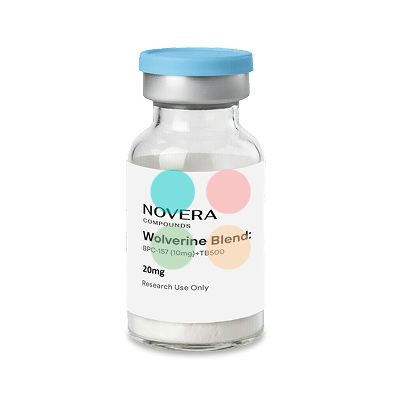
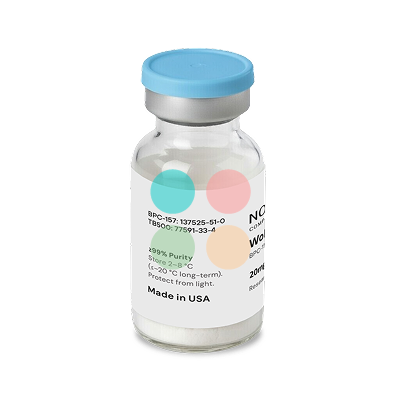
The wolverine blend peptide is a co-formulated research compound that wolverine blend combines two peptides – BPC-157 (body protection compound-157) and TB-500 (a synthetic fragment of Thymosin Beta-4) – studied in animal models for tissue repair across multiple tissue types. Originally isolated from a protein found in human gastric juice, BPC-157 is a 15-amino-acid peptide; TB-500 is derived from the actin-binding region of thymosin β4. The Wolverine Blend combines 10mg of BPC-157 and 10mg of TB-500, and it combines 10mg of BPC-157 and 10mg of TB-500 per dose in typical formulations. Primarily marketed in fitness and biohacking communities, the compound aims to enhance recovery from soft-tissue injuries through complementary mechanisms of tissue regeneration and reduced inflammation.
BPC-157 and TB-500 are not FDA-approved, and the Wolverine Blend is not FDA approved for human use. All products described here are supplied for research and laboratory use only, not for human consumption. Any clinical evidence remains limited, and no form of peptide therapy using these molecules has received regulatory approval for treatment in patients.
General Information About Wolverine Blend
BPC-157 is a synthetic pentadecapeptide (15 amino acids, sequence: GEPPPGKPADDAGLV) with a molecular weight of approximately 1,419 Da. TB-500 corresponds to residues 17–23 of thymosin β4 (sequence: Ac-LKKTETQ), a 7-amino-acid synthetic fragment. There is no standardized formulation or clinically validated ratio for the blend, and published research has only examined each peptide separately.
BPC-157 and TB-500 target different pathways in the healing process. BPC-157 enhances collagen production and angiogenesis, operating through VEGFR2-Akt-eNOS signaling, growth hormone receptor expression in fibroblasts, and nitric oxide modulation. TB-500 promotes cell migration and new blood vessel formation via G-actin sequestration and NF-κB suppression. Together, BPC-157 and TB-500 work through complementary healing mechanisms: BPC-157 creates conditions for repair while TB-500 mobilizes repair cells toward injured tissues.
Plasma half-life data from rodent studies show BPC-157 clears rapidly – roughly 4 minutes after IV administration – while TB-500 persists for 2–3 hours subcutaneously. BPC-157 remains stable in gastric juice for over 24 hours, which researchers find helpful when evaluating oral administration routes.
Wolverine Blend Use in the Research Setting
The wolverine stack is supplied as a lyophilized powder for reconstitution in controlled laboratory settings, intended for laboratory research only.
Tendon and Ligament Healing
Animal studies suggest that BPC-157 may influence healing pathways in fibrous connective tissues, and the blend supports tendon and ligament repair effectively in preclinical models. Cerovecki et al. reported in the 2010 Journal of Orthopaedic Research that intraperitoneal BPC-157 at 10 µg/kg improved biomechanical strength and histological organization in rat medial collateral ligament transection models (Seiwerth S was a co-author). Separately, Chang et al. demonstrated in a 2011 Journal of Applied Physiology study that BPC-157 at 2 µg/ml increased tendon fibroblasts migration approximately 2.3-fold via FAK–paxillin phosphorylation – an in vitro finding relevant to overuse injuries and surgery recovery research.
Citation Capsule: In a 2010 rat MCL transection model, first author Tomislav Cerovecki, published in Journal of Orthopaedic Research, showed that subcutaneous and per-oral BPC-157 at 10 µg/kg led to measurable improvements in load-to-failure biomechanical strength and histological ligament organization compared to untreated controls.
<em>Important to Know:</em>
Injury Recovery
Wolverine Blend accelerates injury recovery through multi-pathway tissue repair in preclinical work. BPC-157 drives blood vessel formation and fibroblast activation at injury sites, while TB-500 is associated with systemic support in tissue recovery via cytoskeletal reorganization. Growth factors and inflammatory cytokines are both modulated. Patients often notice recovery improvements within 1–3 weeks according to anecdotal reports, though controlled human data remain absent. The hype surrounding faster healing in muscle strains and mobility restoration stems largely from animal models rather than clinical trials requiring medical supervision.
Citation Capsule: In a 2025 systematic review by Vasireddi et al. in Orthopedic Sports Medicine, 35 preclinical studies showed BPC-157 improved functional, structural, and biomechanical outcomes in muscle, tendon, ligament, and bony injury recovery models.
“Preclinical models show BPC-157 improved functional, structural, and biomechanical outcomes in muscle, tendon, ligament, and bony injuries.” – Vasireddi et al., 2025
Gut Healing and Gut Health
BPC-157’s affinity for mucosal tissues makes gut healing a prominent focus of published research. Tkalcević et al. reported in a 2007 European Journal of Pharmacology study that the peptide enhanced granulation and collagen organization in wounded gut tissues, with egr-1 gene expression playing a role. The proposed pathway involvement includes nitric oxide modulation, prostaglandin signaling, and possible dopamine system interactions – though no confirmed high-affinity mammalian receptor has been identified. The efficacy of BPC-157 and TB-500 is mostly supported by preclinical studies; all gut health claims remain animal-only or in-vitro-only.
<em>Important to Know:</em>
Reduced Inflammation
Reported benefits include reduced inflammation and improved joint comfort in anecdotal accounts, though formal data come from rodent work. BPC-157 reduces inflammatory cytokines such as TNF-α and IL-6 in colitis and reperfusion models – in some studies rivaling standard NSAIDs. TB-500 suppresses NF-κB–mediated inflammation, contributing to the compound’s anti-inflammatory profile.
“BPC-157 acts at the injury site through angiogenesis and cytoprotection; TB-500 acts inside cells through actin-cytoskeleton regulation and cell migration.”
BPC-157 and TB-500 Interactions (157 and TB 500)
No peer-reviewed study has tested bpc 157 and tb 500 together in a controlled experiment. All synergy claims for the wolverine peptide blend are theoretical, based on mechanistic complementarity. Researchers should determine additive versus antagonistic effects by comparing wolverine blend against single-peptide groups matched for dose and route.
|
Peptide
|
Model
|
Primary Mechanism
|
Representative Result
|
|
BPC-157
|
Rat Achilles tendon transection
|
VEGFR2-Akt-eNOS angiogenesis; FAK/paxillin fibroblast migration
|
~2.3× increased tendon fibroblast migration at 2 µg/ml in vitro (Chang et al., 2011)
|
|
TB-500
|
Dermal wound healing; cardiac injury
|
G-actin sequestration; NF-κB suppression; endothelial cell migration
|
Accelerated re-epithelialization and wound closure in preclinical skin models
|
|
Wolverine Blend (combo)
|
No peer-reviewed controlled model
|
Hypothesized: angiogenesis + migration + anti-inflammatory
|
No published data comparing combined vs. individual peptides
|
Buy Wolverine Blend Online at FillerSupplies.com
Licensed researchers seeking wolverine blend peptide for sale can order the Novera-brand compound online through FillerSupplies.com. Each vial contains approximately 5mg BPC-157 and 10mg TB-500 in lyophilized powder form. Whether your work involves tendon biology, wound healing assays, or inflammation pathways, FillerSupplies.com provides a reliable supply chain for these research-grade peptides and molecules.
-
Authentic, certified products – original, quality-controlled compounds, warehouses worldwide.
-
11 years of reliability & trust – established supplier on the market since 2006.
-
Temperature-controlled shipping – thermal packaging with ice gel / cold packs preserves stability.
-
Express worldwide shipping – next-day dispatch, global delivery.
-
Best wholesale prices – tiered bulk discounts and price-match guarantee.
-
Privacy guaranteed; expert support at (888) 392-6640, WhatsApp and email, Mon-Fri 10am-6pm EST.
-
Supplied for research use only, to licensed professionals.
All products from FillerSupplies.com are supplied exclusively for research and laboratory use, not for human consumption or any compounding pharmacy application without proper licensure.
FAQ
Is Wolverine Blend Safe Based on Current Research?
Serious adverse events have not been reported in published research on either peptide individually. Anecdotal side effects of the blend include local irritation and nausea, with common side effects being injection site irritation and fatigue. Mild nausea and headache may occur early in treatment, and injection site irritation usually resolves within an hour. Long-term human studies on safety are lacking for Wolverine Blend.
How Do BPC-157 and TB-500 Work at the Molecular Level?
BPC-157 signals through VEGFR2, nitric oxide pathways, and FAK/paxillin to accelerate healing in fibroblasts and endothelial cells. TB-500 sequesters G-actin to promote cell migration and suppresses NF-κB to reduce inflammation. These complementary mechanisms create a theoretical basis for the blend's multi-pathway tissue repair profile.
How Does Wolverine Blend Compare to Using a Single Peptide?
No controlled study has compared the blend to either peptide alone, so all synergy claims remain theoretical. BPC-157 alone has deeper quantified data in tendon, ligament, and gut models, while TB-500 contributes more prominently in dermal wound healing and cell migration assays.
What Research Doses and Routes Have Been Studied?
Wolverine Blend is administered via subcutaneous injection in most reported protocols. Injection sites are often near the injury or in the abdomen. In animal models, BPC-157 has been tested at 10 µg/kg and 10 ng/kg intraperitoneally; TB-500 doses range from 60–600 µg/kg subcutaneously. Most patients in anecdotal reports use 2 to 3 vials per month, with typical treatment cycles lasting 4 to 12 weeks.
How Should the Lyophilized Powder Be Stored and Reconstituted?
Lyophilized peptide vials should be stored refrigerated or frozen until reconstitution with bacteriostatic water. BPC-157 shows stability in acidic environments for over 24 hours, but reconstituted solutions degrade without cold storage. No formal stability study exists for the co-lyophilized blend under varied conditions.
Is Wolverine Blend Prohibited in Sports?
BPC-157 is classified under WADA category S0 (non-approved substances), prohibited both in- and out-of-competition. TB-500 falls under WADA category S2. USADA explicitly prohibits both peptides, and no therapeutic use exemption is available for either.
Where Can Researchers Buy Wolverine Blend Peptide Online?
Licensed researchers and medical professionals can purchase wolverine blend peptide for sale at FillerSupplies.com, which offers temperature-controlled shipping, wholesale pricing, and expert support. All purchases are restricted to laboratory research use only.