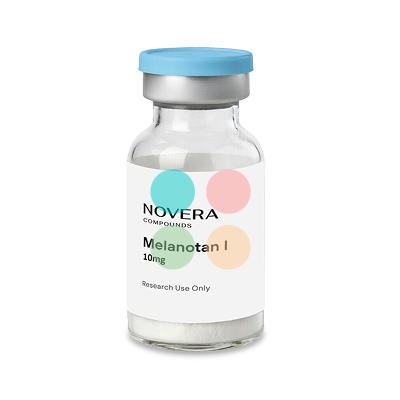
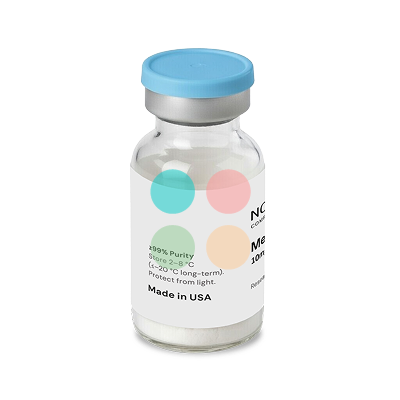
Melanotan I (afamelanotide, NDP-α-MSH) is a synthetic linear tridecapeptide analog of alpha melanocyte stimulating hormone (α-MSH), widely studied in laboratory research for its ability to activate melanocortin receptor signaling – primarily through MC1R – to promote eumelanin synthesis and photoprotection. Structure activity relationship studies demonstrate that two key amino acid substitutions (norleucine at position 4 and D-phenylalanine at position 7) grant Melanotan I substantially greater potency and metabolic stability than native α melanocyte stimulating hormone, making it a valuable reference compound in melanocortin receptor pharmacology and pigmentation research.
For researchers asking where can I buy melanotan peptides of verified quality, FillerSupplies.com supplies Melanotan I under the Novera brand for research and laboratory use only. This peptide is intended exclusively for licensed professionals conducting in vitro, animal-model, or approved clinical investigations – it is not sold for human cosmetic or therapeutic self-administration.
General Information About Melanotan I
Melanotan I is a 13–amino acid linear peptide with the sequence Ac-Ser-Tyr-Ser-Nle⁴-Glu-His-D-Phe⁷-Arg-Trp-Gly-Lys-Pro-Val-NH₂. The core pharmacophore responsible for biological activity is the His-D-Phe-Arg-Trp (Phe Arg Trp Lys–adjacent) tetrapeptide motif retained from native α-MSH. Its molecular weight is approximately 1,645.84 g/mol, and the two structural modifications – methionine → norleucine (oxidation resistance) and L-Phe → D-Phe (protease resistance) – are what distinguish it from the endogenous hormone.
Mechanistically, Melanotan I functions as a melanocortin receptor agonist. Upon receptor activation at MC1R on melanocytes, it stimulates adenylate cyclase, elevating intracyclic AMP (cAMP) levels. This upregulates microphthalmia-associated transcription factor (MITF), which in turn increases expression of key melanogenic enzymes – especially tyrosinase – driving eumelanin production. While Melanotan I shows high affinity for MC1R, it is technically a non selective agonist with measurable receptor activity at multiple melanocortin receptor subtypes (MC1R MC3R MC4R MC5R), though essentially inactive at MC2R. In its FDA-approved implant formulation (Scenesse®, indicated for erythropoietic protoporphyria), the apparent plasma half-life is approximately 15 hours, with plasma concentrations falling below quantitation by day 10 post-implant.
It is important to contextualize Melanotan I alongside related peptides. Melanotan 2 is a synthetic cyclic heptapeptide analogue of α-MSH (CAS 121062-08-6, molecular weight 1024.20 g/mol) that was first synthesized in the 1990s. While both compounds derive from the melanocortin system, Melanotan II‘s cyclic lactam bridge structure makes it a non-selective melanocortin receptor agonist across multiple receptor subtypes MC1R MC3R MC4R and MC5R, producing broader effects including on sexual function, appetite regulation, and energy balance. Additionally, Melanotan 2 is soluble in water and dilute acetic acid and is supplied as a lyophilized powder for research purposes only – it is not approved for human or veterinary use. Native α-MSH, by contrast, has a very short plasma half-life (approximately 30 minutes) and lower potency, limiting its utility in research applications without chemical modification.
Melanotan I Use in the Research Setting
In laboratory research contexts, Melanotan I is typically supplied as a high purity lyophilized powder for reconstitution, intended for research and laboratory use only by qualified researchers.
Melanogenesis and Pigmentation Research
Research shows that Melanotan I significantly increases eumelanin content and tyrosinase activity in human melanocytes in a dose-dependent manner, with preferential stimulation of eumelanin over pheomelanin. In a Phase II clinical study involving 77 Caucasian subjects genotyped for MC1R variant alleles (including Val60Leu, Asp84Glu, Val92Met, Arg151Cys, and Arg160Trp), three 10-day courses of Melanotan I at 0.16 mg/kg/day produced a mean melanin density increase of approximately +0.73 units versus a decrease of approximately –0.30 units in the placebo group.
By comparison, Melanotan II (MT II) – the synthetic cyclic heptapeptide – activates subtypes MC1R MC3R MC4R and MC5R more broadly, producing not only melanin production effects but also off-target actions on sexual arousal, erectile dysfunction pathways, and appetite regulation via MC3R MC4R and MC5R. Reported side effects of Melanotan II include nausea and skin damage, and Melanotan II can cause severe health risks including melanoma. In the context of melanogenesis research, Melanotan I’s more focused MC1R profile makes it a preferred reference compound for isolating pigmentation-specific pathways within the melanocortin system.
Photoprotection Studies
Clinical research in erythropoietic protoporphyria (EPP) demonstrates that 16 mg subcutaneous implants of afamelanotide (Melanotan I) increased absolute skin melanin levels by approximately 28–29% compared to baseline when administered every 60 days. The implant releases more than 90% of the dose by day 5, yet the photoprotective effect persists for 40–60 days, diminishing around day 40–45 post-implant – a pharmacodynamic duration that substantially outlasts measurable plasma concentrations.
Research suggests this sustained photoprotection arises because increased eumelanin deposition in the epidermis continues to absorb and scatter UV radiation long after the peptide itself has been cleared. This is distinct from FDA-approved self-tanners, which function by staining only the outermost layer of skin without altering melanocyte biology.
The following table compares key properties relevant to photoprotection research:
| Property |
Melanotan I (Afamelanotide) |
Melanotan 2 (MT 2) |
Native α-MSH |
| Structure |
Linear, 13 amino acids; Nle⁴, D-Phe⁷ |
Cyclic heptapeptide; Asp-His-D-Phe (Asp His D Phe) lactam bridge |
Linear, 13 amino acids; unmodified |
| Molecular Weight |
~1,645.84 g mol |
1024.20 g mol |
~1,551 Da |
| Receptor Selectivity |
Primarily MC1R; weak at MC3R, MC4R, MC5R |
Non-selective across MC1R MC3R MC4R MC5R |
Non-selective; low potency |
| Plasma Half-Life |
~15 hours (implant formulation) |
Variable; cyclic form more stable than native α-MSH |
~30 minutes |
| Photoprotection Duration |
40–60 days post-implant |
Not clinically established |
Negligible |
| Regulatory Status |
FDA-approved (Scenesse®) for EPP only |
Not approved for human use; Melanotan II is illegal to sell for human use in the US, UK, and EU |
Endogenous hormone |
| Common Side Effects |
Nausea, headache, injection-site reactions |
Nausea, skin damage, sexual side effect, melanoma risk |
None (endogenous) |
Important to Know: Melanotan stimulates melanin production leading to increased risk of darkening moles. Outside approved clinical settings, case reports document rapid growth of pigmented lesions, and researchers should monitor nevi carefully in any model involving prolonged melanocortin receptor agonist exposure.
Receptor Selectivity Research
Melanotan I binds with high affinity to MC1R while showing substantially weaker activity at MC3R, MC4R, and MC5R, and essentially no activity at MC2R. This profile contrasts with Melanotan II, which is classified as a non-selective melanocortin receptor agonist with significant engagement across multiple receptor subtypes (MC1R MC3R MC4R MC5R). Binding affinity data from the literature places NDP-MSH analogues in the low nanomolar to sub-micromolar range for MC1R; related cyclic melanocortin analogues show IC₅₀ values of approximately 155 ± 16 nM, providing useful context for comparative melanocortin receptor pharmacology.
The broader receptor profile of Melanotan II explains its additional effects on sexual function, sexual arousal, and appetite regulation through MC4R – pathways not significantly activated by Melanotan I at research-relevant concentrations. Studies in the literature have also linked unregulated use of Melanotan II with rare but serious adverse events including renal infarction.
Important to Know: Despite its relative MC1R selectivity, Melanotan I is not entirely devoid of activity at other melanocortin receptor subtypes. Long-term safety data outside the approved EPP indication remain limited, and researchers should consider potential off-target effects when designing protocols. Products sold online may contain contaminants and unknown impurities, and health authorities advise against purchasing unregulated tanning products online. There are no legal stores selling Melanotan II for cosmetic tanning. Melanotan II is often sold in the gray market labeled as research chemicals.
Stability and Formulation Studies
As a linear peptide, Melanotan I is inherently less stable in circulation than cyclic analogs such as Melanotan 2 (MT 2). However, its D-Phe⁷ and Nle⁴ modifications confer meaningful resistance to proteolysis and oxidation, respectively – a key insight from decades of structure activity relationship studies in the melanocortin field.
“The minimal sequence required for the biological activity of α-MSH is His⁶-Phe⁷-Arg⁸-Trp⁹, and substitution by D-Phe and norleucine increases potency and stability over native α-MSH.”
In implant formulations (Scenesse®), more than 90% of the dose is released by day 5, with the implant matrix fully bioresorbed by approximately 60 days. For lyophilized powder used in laboratory research, proper storage requires refrigeration or freezing, protection from moisture and light, and reconstitution in sterile water or appropriate buffer immediately prior to use. These stability considerations are critical for researchers maintaining stock of Melanotan I for ongoing experimental protocols.
Buy Melanotan I Online at FillerSupplies.com
For qualified researchers and medical professionals seeking to discover a reliable source for Melanotan I, FillerSupplies.com offers this peptide under the Novera brand with the commitment to quality and service that researchers require. Whether you are investigating melanocortin receptor pharmacology, melanogenesis pathways, or photoprotection mechanisms, you can contact our team for pricing, bulk orders, and technical support.
- Authentic, certified products – original, quality-controlled compounds, warehouses worldwide.
- 11 years of reliability & trust – established supplier on the market since 2006.
- Temperature-controlled shipping – thermal packaging with ice gel / cold packs preserves stability.
- Express worldwide shipping – next-day dispatch, global delivery.
- Best wholesale prices – tiered bulk discounts and price-match guarantee.
- Privacy guaranteed; expert support at (888) 392-6640, WhatsApp and email, Mon–Fri 10am–6pm EST.
- Supplied for research use only, to licensed professionals.
If you have been searching where can I buy melanotan 2 as well, note that Melanotan 2 is available for research purposes only through FillerSupplies.com – it is not approved for human or veterinary use. All peptides supplied by FillerSupplies.com are intended exclusively for research and laboratory use by qualified professionals.
Related research peptides available at FillerSupplies.com: PT-141.
FAQ
What Is Melanotan I and How Does It Differ From Melanotan II?
Melanotan I is a linear 13–amino acid analog of α melanocyte stimulating hormone (α MSH) with high affinity for MC1R, primarily studied for melanin production and photoprotection. Melanotan II is a synthetic cyclic heptapeptide analogue of α-MSH that acts as a non selective agonist across multiple melanocortin receptor subtypes, producing additional effects on sexual function, appetite regulation, and energy balance. Melanotan I's narrower receptor profile results in fewer off-target side effects in clinical research.
Is Melanotan I Safe for Research Use?
In approved clinical trials for erythropoietic protoporphyria, Melanotan I (afamelanotide) demonstrated a favorable safety profile with adverse events limited to injection-site reactions, nausea, fatigue, and headaches. However, long-term safety data outside the approved indication are limited, and researchers should review the current literature and institutional safety protocols before initiating any study. Melanotan stimulates melanin production leading to increased risk of darkening moles, which warrants monitoring in any experimental context.
How Does Melanotan I Promote Melanin Production?
Melanotan I activates MC1R on melanocytes, triggering adenylate cyclase and elevating cAMP levels. This upregulates MITF and increases expression of melanogenic enzymes, especially tyrosinase, leading to dose-dependent eumelanin synthesis. Research suggests this mechanism is more selective than that of Melanotan II, which broadly engages MC3R, MC4R, and MC5R.
What Are Common Research Dosing Ranges for Melanotan I?
In vitro studies typically employ nanomolar to sub-micromolar concentrations for melanocyte cell lines. In human clinical trials for EPP, afamelanotide was administered as a 16 mg subcutaneous implant every 60 days; in pigmentation studies with Caucasian subjects, the dose was 0.16 mg/kg/day injected subcutaneously for 10-day courses. Researchers should adapt doses to their specific model and consult institutional review protocols.
How Should Melanotan I Be Stored and Reconstituted?
Melanotan I lyophilized powder should be stored refrigerated or frozen, protected from moisture and light. Reconstitution is typically performed in sterile water or an appropriate buffer immediately before use. Once reconstituted, the solution should be used promptly or aliquoted and refrozen to maintain peptide stability throughout ongoing research applications.
Is Melanotan I on the WADA Prohibited Substances List?
Yes. Melanotan I and related melanocortin peptides are included on the World Anti-Doping Agency (WADA) Prohibited List under the category of peptide hormones and growth factors. Researchers working with athletic populations or in sports science contexts should be aware of this classification and ensure appropriate documentation and compliance.
Where Can I Buy Melanotan for Research Purposes?
Licensed researchers and medical professionals can buy Melanotan I and Melanotan 2 for research purposes at FillerSupplies.com. All products are supplied for research and laboratory use only, with temperature-controlled shipping and expert support. Contact the team at (888) 392-6640 for pricing, availability, and bulk discount information.
- FitzGerald, L. M., et al. (2006). Effect of MELANOTAN, [Nle4, D-Phe7]-alpha-MSH, on melanin synthesis in humans with MC1R variant alleles. Peptides, 27(2), 388-394. https://doi.org/10.1016/j.peptides.2004.12.038
- Humphrey, S., et al. (2004). Clinical potential of Melanotan (NDP-alpha-MSH) in skin protection. Experimental Dermatology, 13(Suppl 4), 12-14. https://doi.org/10.1111/j.0906-6705.2004.0212ar.x
- Brennan, R., et al. (2014). An unhealthy glow? A review of melanotan use and associated clinical outcomes. Performance Enhancement & Health, 3(2), 78-92. https://doi.org/10.1016/j.peh.2015.06.001