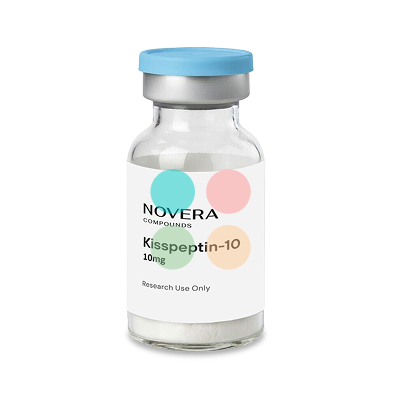
Kisspeptin-10 is a synthetic decapeptide derived from the KISS1 gene product, studied extensively for its role in activating gonadotropin releasing hormone (GnRH) pathways and regulating reproductive hormone release across mammalian research models. With a molecular weight of 1302.4 g/mol and the sequence Tyr-Asn-Trp-Asn-Ser-Phe-Gly-Leu-Arg-Phe-NH₂, this c terminal fragment of the kisspeptin precursor protein retains full binding activity at KISS1R receptors-making it one of the most widely used smaller peptides in hypothalamic-pituitary-gonadal (HPG) axis research.
FillerSupplies.com supplies kisspeptin 10 exclusively for laboratory research under the Novera brand. Kisspeptin-10 has no FDA-approved therapeutic indication, is not available as a standard over-the-counter dietary supplement, and is explicitly labeled for research use only. Every unit shipped carries clear label information confirming its intended application in licensed scientific settings, not human consumption or self-administration.
General Information About Kisspeptin-10
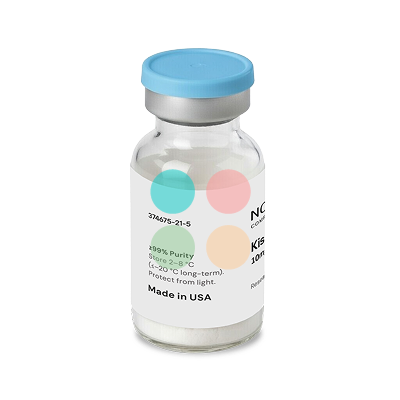
The KISS1 gene encodes a precursor protein of approximately 145 amino acids. Post-translational processing yields several active fragments-KP-54, KP-14, KP-13, and KP-10-all sharing an identical c terminal decapeptide motif. KP-10 (also referenced as metastin 45 54 in some nomenclature systems, CAS 374675-21-5) represents the minimal biologically active sequence capable of full kisspeptin receptor activation.
At the molecular level, kisspeptin-10 binds KISS1R (formerly GPR54), a g protein coupled receptor coupled to Gαq/11 signaling. Receptor engagement triggers phospholipase C activation, which in turn generates IP₃ and DAG second messengers, leading to intracellular calcium mobilization. This signaling cascade can possibly stimulate calcium mobilization in gnrh neurons within the hypothalamus, prompting gnrh release and subsequent secretion of luteinizing hormone (LH) and FSH from the anterior pituitary. Kisspeptin acts at the apex of the hypothalamic-pituitary-gonadal axis, positioning it as a master regulator upstream of reproductive hormone regulation.
Loss-of-function mutations in KISS1 or KISS1R genes produce hypogonadotropic hypogonadism in humans-a failure of puberty onset caused by absent GnRH activation. Kisspeptin-10 is linked to hypogonadotropic hypogonadism research precisely because it can rescue GnRH signaling in receptor-competent models. Conversely, activating mutations in these same genes are associated with precocious puberty, underscoring the dose- and context-dependent nature of kisspeptin excitation within the HPG axis.
Pharmacokinetically, the peptide clears rapidly from circulation. A 2011 human pharmacokinetic study measured a plasma half-life of approximately 3.8 ± 0.3 minutes in men and 4.1 ± 0.4 minutes in women during follicular and preovulatory phases. This short duration reflects rapid enzymatic degradation, a characteristic that distinguishes KP-10 from longer kisspeptin forms and influences experimental design in laboratory research.
Kisspeptin-10 Use in the Research Setting
Supplied as a lyophilized white powder for reconstitution in sterile water or appropriate buffer, kisspeptin-10 is intended strictly for research and laboratory use only. Below are the principal domains of investigation where this molecule has generated significant findings across in vitro and animal studies.
LH and FSH Secretion via HPG Axis Activation
Kisspeptin-10 may stimulate GnRH release from hypothalamic neurons, and the downstream consequence most frequently measured in research models is a rise in circulating luteinizing hormone. Dhillo et al. reported in a 2005 human study that bolus IV administration of KP-10 at doses of 0.03, 0.1, 0.3, and 1.0 µg/kg produced significant, dose-dependent LH elevation within minutes in healthy men. Notably, a higher dose of 3 µg/kg did not further increase LH beyond the 1.0 µg/kg response, suggesting receptor saturation or desensitization at the pituitary level.
In mice, Thompson and colleagues demonstrated in 2004 that intraperitoneal doses of 0.3 to 30 nmol KP-10 raised both plasma LH and testosterone at 20 minutes post-injection, with statistical significance at doses ≥1 nmol. The analog [dY]¹KP-10 proved more potent than wild type KP-10 at equivalent concentrations, pointing to the importance of residues at positions 1 and 10 for in vivo biological activity.
Kisspeptin-10 can influence the release of FSH and LH hormones, though FSH responses are generally more modest than LH elevations. The compound can also induce a ~3x increase in testosterone synthesis in male animal models-a finding consistent with its upstream activation of gonadotropin secretion rather than direct gonadal stimulation.
<em>Important to Know:</em>
Comparison with Kisspeptin-54 in Research
Researchers frequently compare KP-10 and KP-54 to select the appropriate tool for their experimental design. Both peptides show equivalent receptor binding affinity in vitro, but their in vivo pharmacokinetic profiles differ substantially.
|
Parameter
|
Kisspeptin-10 (KP-10)
|
Kisspeptin-54 (KP-54)
|
|
Length
|
10 amino acids
|
54 amino acids
|
|
Molecular Weight
|
1302.4 g mol⁻¹
|
~5860 g mol⁻¹
|
|
Human Half-Life (IV)
|
~3.8–4.1 minutes
|
~27–32 minutes
|
|
Duration of LH Elevation
|
Peak at ~10–60 min, rapid decline
|
Sustained 1–4 hours after single dose
|
|
BBB Penetration (Peripheral Delivery)
|
Limited
|
Greater in some models
|
|
Synthesis Cost
|
Lower (shorter sequence)
|
Higher (longer peptide, more difficult purification)
|
|
Desensitization Risk
|
Observed at high/repeated doses
|
Less pronounced with single bolus
|
Although KP-54 and KP-10 show similar receptor binding affinities and bioactivities in vitro, a direct comparison of their potencies in vivo demonstrates that KP-54 can sustain LH release far longer than KP-10-a critical consideration when designing experiments requiring prolonged hormonal stimulation.
KP-10’s rapid clearance makes it better suited for studying acute, pulsatile activation of gnrh neurons, while KP-54 serves protocols requiring extended hormonal exposure. For budget-sensitive studies or high-throughput receptor binding assays in vitro, the lower synthesis cost and equivalent receptor affinity of KP-10 often make it the preferred molecule.
Hypothalamic Signaling and Neuropeptide Interactions
Beyond direct GnRH regulation, kisspeptin-10 intersects with several hypothalamic neuropeptides and neurotransmitters involved in metabolic and behavioral regulation. Kisspeptin-10 may regulate energy balance through hypothalamic interactions, and emerging in vitro data suggest cross-talk with neuropeptide y and appetite regulation pathways in hypothalamic cells, though these findings remain preliminary.
Orlando G. and colleagues have explored kisspeptin’s effects on brain derived neurotrophic factor expression and downstream neurotransmitter metabolism, including dopamine, serotonin, and their metabolites such as dihydroxyphenylacetic acid. Kisspeptin-10 may enhance limbic brain activity, a finding from functional neuroimaging studies suggesting the compound influences emotional brain processing beyond pure endocrine effects. Kisspeptin modulates sexual behavior-related neural circuits, and research by Stefanucci A., Mollica A., and Dimmito MP has examined structure-activity relationships of kisspeptin analogs in these contexts.
One notable neuroprotective finding: kisspeptin-10 may protect neurons from α-synuclein (α syn) toxicity, potentially through mechanisms involving mitochondrial depolarization and apoptosis pathways. These observations remain at the cell culture level and require validation in animal models before broader conclusions can be drawn.
Citation Capsule: Kiss1 neurons sit where reproductive and metabolic signalling meet, so rodent work has examined central kisspeptin for effects on feeding alongside its established role in gonadotropin release. The metabolic strand of that literature remains far thinner than the reproductive one.
Anti-Metastatic and Cancer Research Applications
The KISS1 gene was originally identified not for its reproductive role but as a metastasis suppressor in melanoma cell lines. Kisspeptin-10 may reduce cancer cell migration, and in vitro studies across breast cancer, melanoma, and pancreatic tumor models have demonstrated that the peptide can inhibit cell migration and invasion through KISS1R-dependent and, in certain contexts, kisspeptin receptor independent manner pathways. Some researchers have reported that KP-10 may also induce apoptosis in specific cancer cell lines, though concentrations required for these effects often exceed physiological levels.
Research into tumor metastasis suppression by kisspeptin continues, with particular interest in how the peptide affects arachidonic acid release and downstream eicosanoid signaling in cancer cells. Evidence remains largely in vitro, and animal model validation with KP-10 specifically-as opposed to overexpression of the full KISS1 gene-is still limited.
<em>Important to Know:</em>
Pulsatility and Sex-Specific Responses
In ovariectomized female rats, Navarro and colleagues demonstrated in 2005 that IV infusion of KP-10 at 7.5, 35, and 100 nmol produced dose-dependent LH increases. Interestingly, multiunit electrode recordings in the arcuate nucleus showed no change in GnRH pulse generator electrical activity, suggesting that the peptide increases LH through a mechanism that does not necessarily alter central pulse generator firing frequency under those experimental conditions.
Sex differences in response magnitude have been noted across species. Kisspeptin-10 can stimulate gonadotropin-releasing hormone release in both sexes, but the degree of LH and FSH response varies with hormonal milieu. Female research models in preovulatory phases show different response amplitudes compared to males, despite similar peptide half-lives (~4 minutes in both). Expression levels of KISS1R in various hypothalamic nuclei and their regulation by circulating sex steroids likely account for these differences.
In a 2011 pharmacokinetic study, the half-life of KP-10 was measured at 3.8 ± 0.3 minutes in men and 4.1 ± 0.4 minutes in women during follicular and preovulatory phases-establishing that rapid clearance is consistent across sexes in human subjects.
Citation Capsule: Thompson and colleagues showed in 2004 that intraperitoneal injection of 1 nmol KP-10 in mice increased plasma LH by approximately 3-fold within 20 minutes versus saline controls, while the modified analog [dY]¹KP-10 achieved comparable activation at lower doses-demonstrating that single-residue substitutions can substantially alter in vivo potency of these molecules (Molecular Pharmacology).
Buy Kisspeptin-10 Online at FillerSupplies.com
For researchers asking where to buy kisspeptin-10 peptide at competitive kisspeptin-10 price points, FillerSupplies.com provides a direct, reliable source. Whether you need to buy kisspeptin 10mg for a pilot study or require larger quantity orders for multi-arm protocols, the Novera-branded compound is available with verified sku reference numbers and complete documentation. As part of a broader molecular sciences catalog-distinct from the Alfa Aesar product portfolio or Thermo Scientific Chemicals offerings following any brand transition or legacy brand restructuring in the chemical supply industry-FillerSupplies.com focuses exclusively on serving the research community.
-
Authentic, certified products – original, quality-controlled compounds, warehouses worldwide.
-
11 years of reliability & trust – established supplier on the market since 2006.
-
Temperature-controlled shipping – thermal packaging with ice gel / cold packs preserves stability.
-
Express worldwide shipping – next-day dispatch, global delivery.
-
Best wholesale prices – tiered bulk discounts and price-match guarantee.
-
Privacy guaranteed; expert support at (888) 392-6640, WhatsApp and email, Mon–Fri 10 am–6 pm EST.
-
Supplied for research use only, to licensed professionals.
Buy kisspeptin-10 with confidence knowing every shipment is dispatched under conditions designed to preserve peptide stability and biological activity for your laboratory research applications.
Related research peptides available at FillerSupplies.com: Gonadorelin, Sermorelin, Hexarelin.
FAQ
Is Kisspeptin-10 Safe For Human Use?
Kisspeptin-10 has no FDA-approved therapeutic indication and is not approved for general human use. Compounded drugs containing kisspeptin are not premarket-reviewed for safety or efficacy, and long-term safety data for self-administration do not exist. The compound is supplied exclusively for research use by licensed professionals in controlled laboratory settings.
How Does Kisspeptin-10 Stimulate Reproductive Hormone Release?
The peptide binds KISS1R, a g protein coupled receptor on GnRH neurons in the hypothalamus. Receptor activation triggers intracellular calcium mobilization through the phospholipase C pathway, which prompts gnrh release into the hypophyseal portal system. Downstream, this stimulates luteinizing hormone and FSH secretion from anterior pituitary gonadotropes-kisspeptin-10 can increase testosterone synthesis by approximately 3x in male animal models through this indirect mechanism.
How Does Kisspeptin-10 Compare To Kisspeptin-54 For Research?
Both peptides bind KISS1R with equivalent affinity in vitro, but KP-54 has a substantially longer half-life (~27–32 minutes vs. ~4 minutes for KP-10) and sustains LH elevation for 1–4 hours after a single peripheral dose. KP-10 is preferred for studying acute pulsatile GnRH activation, while KP-54 suits protocols requiring prolonged hormonal stimulation. Cost is also a factor: KP-10 is less expensive to synthesize due to its shorter sequence.
What Doses Are Used In Animal Research Models?
Published rodent studies typically employ 0.3–30 nmol via intraperitoneal injection in mice or 7.5–100 nmol IV in rats. In prepubertal ewes, IV doses of 0.5–2 mg have produced dose-dependent LH peaks at approximately 30 minutes. These figures are drawn from peer-reviewed animal research and should not be extrapolated to human use under any circumstances.
How Should Kisspeptin-10 Be Stored In The Laboratory?
Store the lyophilized powder at –20°C under desiccated conditions. Once reconstituted in sterile water or buffer, aliquot and freeze at –20°C or below to minimize degradation. Avoid repeated freeze-thaw cycles, as peptide stability and binding function decline with each cycle. Reconstituted solutions should be used promptly in experimental protocols.
Is Kisspeptin Prohibited In Sport?
Yes. Kisspeptin is prohibited by the World Anti-Doping Agency under the category of peptide hormones and hormone modulators, banned both in- and out-of-competition. Purchasing or administering kisspeptin for performance enhancement purposes is a violation of WADA regulations regardless of the source.
Where Can I Buy Kisspeptin-10 For Research?
Licensed researchers can buy kisspeptin at FillerSupplies.com, which stocks Novera-branded KP-10 in 1 mg and larger research quantities. Orders ship worldwide with temperature-controlled packaging. A valid institutional affiliation or research license is expected for purchase, as the compound is supplied strictly for research use.