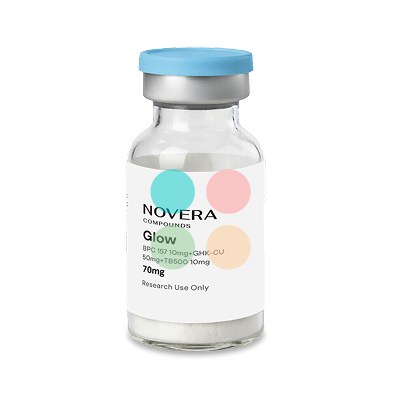
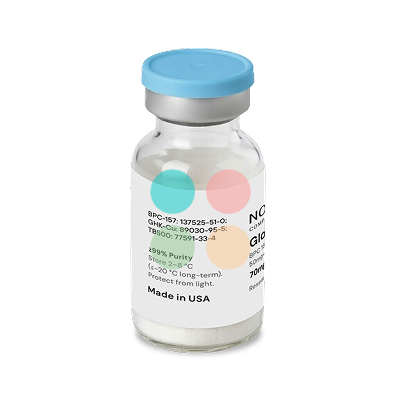
Glow Blend Peptide is a research formulation combining three distinct peptides: BPC-157, TB-500, and GHK-Cu. Each component targets a separate biological pathway involved in tissue repair, collagen synthesis, and cellular regeneration. GLOW combines BPC-157, TB-500, and GHK-Cu peptides in a single vial containing 10 mg BPC-157, 10 mg TB-500, and 50 mg GHK-Cu, for a total weight of 70 mg per vial. Investigators studying wound healing, extracellular matrix remodeling, and angiogenesis in preclinical models use this multi peptide formulation to explore whether combining bpc 157 tb 500 and ghk cu produces outcomes beyond what individual peptides achieve alone.
Glow Blend products are sold as lyophilized powders for research use only. Research vendors label the blend strictly for laboratory or in vitro research use; it is not intended for human consumption, diagnosis, prevention, or treatment of any condition. No regulatory authority, including the FDA, has approved any component of this blend for clinical use in humans. All findings discussed below derive from animal or in vitro studies unless otherwise specified.
General Information About Glow Peptide Blend
The glow peptide blend consists of three components with distinct chemical identities and mechanisms of action.
BPC-157 is a synthetic 15-amino-acid peptide derived from a protective protein in human gastric juice, with a molecular weight of approximately 1,419 Da. In preclinical research contexts, BPC-157 modulates nitric oxide pathways by upregulating vascular endothelial growth factor (VEGF) and endothelial nitric oxide synthase (eNOS). The compound also enhances cell migration through FAK/paxillin signaling in tendon fibroblasts. No reliable human pharmacokinetic data exist for this peptide; animal work suggests biological effects persist over days in injury models.
TB-500 is a synthetic version of a cellular repair protein; specifically, it reproduces the actin-binding domain (amino acids 17–23) of Thymosin β-4, with a molecular weight of approximately 796 Da. TB-500 promotes cellular migration by sequestering G-actin and enabling actin polymerization, which influences cytoskeletal dynamics critical to wound closure. Its anti-inflammatory effects operate through suppression of NF-κB activation. No published pharmacokinetic study has determined the plasma half-life of the TB-500 fragment in any species; based on its small size and lack of stabilizing modifications, clearance is inferred to occur within minutes to a few hours.
GHK-Cu is a naturally occurring copper-binding tripeptide (glycyl-L-histidyl-L-lysine complexed with Cu²⁺) found in human plasma, saliva, and urine. GHK-Cu controls matrix metalloproteinases (MMPs), upregulates genes for collagen I, collagen III, elastin, and glycosaminoglycans, and reduces oxidative stress in dermal fibroblasts. Gene expression profiling studies indicate GHK-Cu modulates thousands of genes, making it the most broadly active of the three components at the transcriptional level. An ongoing Phase 2 clinical trial (NCT07437586) is evaluating topical GHK-Cu gel for acute skin wound healing in healthy adults, with primary endpoints expected by early 2027.
The blend is supplied as a lyophilized powder requiring cold storage at temperatures below -20 °C to preserve stability.
Glow Peptide Blend Use in the Research Setting
Glow Blend is delivered as a lyophilized powder intended exclusively for laboratory research use. All protocols described below involve animal or in vitro models. No peer-reviewed controlled trial has tested the triple formula against its individual peptides in the same experimental model as of mid-2026.
Tissue Repair and Wound Healing
The blend is studied for enhanced wound healing and scar reduction across multiple tissue types. BPC-157 promotes muscle-to-bone reattachment in preclinical models; in a 2022/2023 rat study of quadriceps muscle reattachment, treated groups showed higher structural integration scores (measuring vascularization, cellularity, and collagen organization) by 28–60 days post-surgery compared to untreated controls. TB-500 enhances cellular migration and reduces fibrosis during healing, an effect attributed to its actin-sequestration mechanism. GHK-Cu improves skin elasticity by 20–30% in some models and accelerates wound contraction and epithelialization.
Research timelines from individual peptide studies suggest initial improvements may occur within 1–2 weeks, more noticeable effects may take 4–6 weeks, and full collagen benefits may require 8–12 weeks. BPC-157 shows complete recovery in 90 days in certain tendon transection studies. Results vary based on specific research parameters including injury type, administration route, and species.
In Staresinic et al.’s 2003 rat Achilles tendon transection model published in the Journal of Orthopaedic Research, daily BPC-157 treatment at 10 μg/kg restored biomechanical load failure, increased Young’s modulus, and normalized collagen architecture by day 14 compared to persistent defects in saline-treated controls.
Collagen Synthesis and Matrix Remodeling
GHK-Cu demonstrates the strongest individual collagen synthesis capacity among the three components. Human dermal fibroblasts exposed to GHK-Cu at concentrations of 0.1–10 µM show increased mRNA and protein levels of collagen I and collagen III within 24–72 hours, alongside suppression of MMP-1 and MMP-9, and increased tissue inhibitor of metalloproteinase (TIMP) expression. TB-500 influences organized collagen deposition patterns through its effects on cytoskeletal remodeling, which helps orient fibroblasts during repair. BPC-157 contributes to collagen formation indirectly by increasing vascular supply to injured tissue, ensuring adequate nutrient delivery during matrix production.
The rationale for combining bpc 157 tb 500 and ghk cu in a single blend rests on this mechanistic complementarity: one peptide supplies blood vessels, another mobilizes repair cells, and the third directly produces the structural proteins. No published study has quantified whether the combination produces additive or synergistic collagen production compared to any single component.
|
Peptide
|
Model / Route
|
Dose (Animal/In Vitro)
|
Collagen-Related Outcome
|
Timeframe
|
|
BPC-157
|
Rat Achilles tendon, intraperitoneal
|
10 μg/kg daily
|
Normalized collagen architecture and increased biomechanical strength
|
Day 14 post-transection
|
|
GHK-Cu
|
Human dermal fibroblasts, in vitro
|
0.1–10 µM
|
Upregulated collagen I and III mRNA/protein; suppressed MMP-1 and MMP-9
|
24–72 hours
|
|
GHK-Cu
|
Rabbit skin wound, topical
|
Variable (% w/w in gel)
|
Faster wound contraction; increased granulation tissue formation
|
Days 7–14 versus vehicle
|
|
TB-500
|
Rodent/in vitro injured tissue
|
Varied (often parent Tβ4 protein used)
|
Enhanced fibroblast migration; reduced fibrosis markers
|
Days to weeks post-injury
|
Angiogenesis and Vascular Formation
All three components independently promote new blood vessel formation, though through distinct pathways. BPC-157 consistently upregulates VEGF and eNOS in animal models of gastrointestinal ulceration and tendon injury, producing measurable increases in capillary density at injury sites. TB-500, and its parent protein Thymosin β-4, stimulates angiogenesis in cardiac ischemia and corneal wound models by promoting endothelial cell migration. GHK-Cu supports vascular formation through copper-dependent endothelial signaling in skin wound models.
Gwyer, Wragg, and Wilson noted in their 2019 review in Cell and Tissue Research that every animal study examining BPC-157 in musculoskeletal soft tissue repair found consistent healing improvements, including increased vascularization in hypovascular tissues, without reported adverse events.
Anti-Inflammatory Properties
Each component reduces inflammation through a different mechanism. BPC-157 reduces neutrophil and granulocyte infiltration in injured tendons and modulates cytokine release in rat models (Staresinic et al., 2003, Journal of Orthopaedic Research). TB-500 reduces NF-κB activation in ischemic tissue and lowers concentrations of pro-inflammatory cytokines in animal injury models. GHK-Cu decreases IL-6 and TNF-α in skin fibroblasts and increases antioxidant enzyme activity, including glutathione and ascorbate levels, in animal wound preparations.
The proposed synergy for inflammation control relies on BPC-157 addressing acute infiltration, TB-500 suppressing transcriptional activation of inflammatory cascades, and GHK-Cu reducing oxidative damage downstream. Quantified data comparing the triple blend to individual peptides for anti-inflammatory endpoints does not exist in published literature.
Important to Know: WADA classifies BPC-157 under S0 (non-approved substances) and TB-500 as a derivative under S2 (peptide hormones and growth factor mimetics). GHK-Cu is not named directly in WADA’s prohibited list, but it could fall under catch-all provisions covering growth factor modulators. Any research involving athletes or sport-tested subjects must account for these classifications.
Musculoskeletal Research Applications
BPC-157 promotes muscle-to-bone reattachment in preclinical studies. In a rat quadriceps detachment model, BPC-157 administration after surgical detachment produced healing assessment scores (measuring vascularization, cellularity, and collagen alignment) that exceeded untreated controls by 28–60 days post-surgery. The Gwyer et al. 2019 review confirmed that every injury model examined with BPC-157 in musculoskeletal soft tissues showed measurable benefit.
TB-500 enhances cellular migration and reduces fibrosis, properties relevant to preventing scar-tissue barriers that impede structural reintegration. Its evidence base for deep musculoskeletal interfaces (tendon-to-bone, ligament insertion) relies primarily on in vitro myoblast and tendon fibroblast migration assays rather than whole-animal structural testing. GHK-Cu is studied principally in dermal connective tissues rather than deep musculoskeletal structures; its contribution to this application category remains theoretical.
Gwyer, Wragg, and Wilson reported in their 2019 Cell and Tissue Research review that all examined animal models of BPC-157 in musculoskeletal soft tissue produced positive healing outcomes without reported adverse events across tendon, ligament, and muscle injury types.
No published animal study has tested the complete glow blend (all three peptides together) for large structural healing such as tendon-to-bone reattachment over months.
Buy Glow Peptide Blend Online at FillerSupplies.com
FillerSupplies.com offers glow blend peptide for sale as a research-grade formulation under the Novera brand. Glow Blend products are distributed through medical clinics and online research suppliers, and FillerSupplies.com maintains a commitment to providing authenticated peptide research compounds to licensed professionals worldwide. Glow peptide pricing ranges from $110 to $195 per vial depending on quantity, and bulk discounts can reduce prices to $127–$156 per vial. When you buy glow peptide blend from FillerSupplies.com, each batch ships with temperature-controlled packaging to preserve the lyophilized powder during transit. For researchers ready to buy, glow blend peptide buy options are available directly through the product page.
-
Authentic, certified products; original, quality-controlled compounds, warehouses worldwide.
-
11 years of reliability & trust; established supplier on the market since 2006.
-
Temperature-controlled shipping; thermal packaging with ice gel / cold packs preserves stability.
-
Express worldwide shipping; next-day dispatch, global delivery.
-
Best wholesale prices; tiered bulk discounts and price-match guarantee.
-
Privacy guaranteed; expert support at (888) 392-6640, WhatsApp and email, Mon–Fri 10am–6pm EST.
-
Supplied for research use only, to licensed professionals.
All glow blend products shipped by FillerSupplies.com are designated for laboratory research use only and are not intended for human consumption, diagnosis, prevention, or treatment.
FAQ
What Is Glow Blend Peptide Used For In Research?
Glow Blend is studied in laboratory settings for tissue repair, wound healing, collagen synthesis, and angiogenesis. Researchers investigate how combining BPC-157, TB-500, and GHK-Cu in a single formulation affects these processes in animal and in vitro models. The blend is marketed for skin regeneration and connective-tissue repair research.
How Does Glow Blend Compare To Individual BPC-157, TB-500, Or GHK-Cu?
Each component targets a different pathway: BPC-157 drives vascularization via VEGF/eNOS, TB-500 promotes cellular migration through actin sequestration, and GHK-Cu upregulates collagen genes and suppresses MMPs. No peer-reviewed study has directly compared the triple blend to individual peptides in the same controlled model. The theoretical basis for combining them rests on mechanistic complementarity rather than demonstrated synergy.
What Are The Storage Requirements For Glow Peptide Blend?
The lyophilized powder should be stored at temperatures below -20 °C to maintain stability. Once reconstituted, the solution should be kept refrigerated and used within a timeframe consistent with the specific research protocol. Repeated freeze-thaw cycles degrade peptide integrity.
Is Glow Blend Peptide Banned By WADA?
BPC-157 falls under WADA's S0 category (non-approved substances), and TB-500 is classified under S2 (peptide hormones and growth factor mimetics). GHK-Cu is not explicitly named but could fall under catch-all provisions for growth factor modulators. Research involving sport-tested subjects must account for all three classifications.
What Research Dosing Ranges Have Been Studied?
Animal studies of BPC-157 have used intraperitoneal doses of 10 μg/kg, 10 ng/kg, and 10 pg/kg in rat tendon models (Staresinic et al., 2003). GHK-Cu concentrations of 0.1–10 µM are typical in fibroblast culture assays. TB-500 fragment dosing is less standardized in published literature, with many studies using the parent Thymosin β-4 protein instead.
How Should Glow Peptide Blend Be Reconstituted For Research?
The lyophilized powder is typically reconstituted with bacteriostatic water or sterile saline, depending on the intended research application. Gentle swirling rather than vigorous shaking preserves peptide structure. Specific reconstitution volumes depend on the desired concentration for the given experimental protocol.
Where Can I Buy Authentic Glow Peptide Blend?
FillerSupplies.com stocks glow blend peptide for sale under the Novera brand, with temperature-controlled shipping and tiered wholesale pricing. Same-day shipping is offered for orders placed before 2 PM EST. All products are supplied exclusively for laboratory research and are not intended for human consumption.