Key takeaways
-
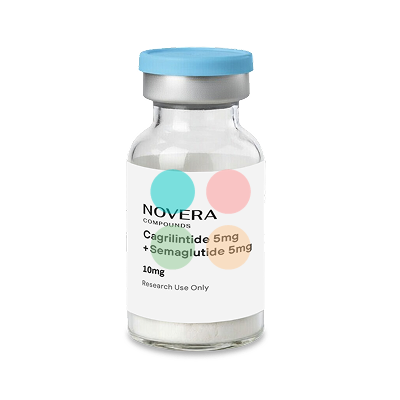
CagriSema is the fixed dose combination of cagrilintide and semaglutide, pairing a long acting amylin analog with a GLP-1 receptor agonist; Novera products are supplied strictly for research and laboratory use, not for human therapy or self-administration.
-
In double blind placebo controlled clinical trials, adults with overweight or obesity achieved mean weight reduction of approximately 13 to 20% over 68 to 72 weeks; these were monitored medical studies, not usage guidance.
-
The two molecules exert a complementary effect on appetite regulation, gastric emptying, and glucose homeostasis through direct actions on distinct brain regions and peripheral tissues.
-
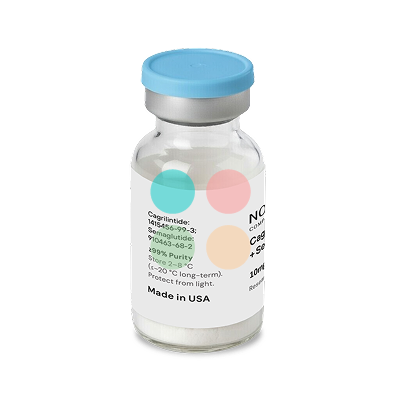
Novera Cagrilintide + Semaglutide is supplied as a lyophilized peptide powder for reconstitution in controlled in-vitro or in-vivo experimental protocols under licensed institutional oversight.
-
Qualified investigators can buy Cagrilintide + Semaglutide online from FillerSupplies.com with temperature-controlled shipping, wholesale pricing, and expert support.
Cagrilintide and semaglutide are injectable peptide medications studied for metabolic health, and CagriSema is the fixed-dose co-formulation of the two agents in a once-weekly regimen. Developed by Novo Nordisk under the designation NN-9388, this investigational compound targets both amylin and GLP-1 receptor pathways to address excess body weight, obesity related complications, and type 2 diabetes in controlled research study settings. Combining the two agents enhances weight loss beyond what either achieves alone, a finding that has generated broad interest across the weight management and public health research communities.
FillerSupplies.com supplies the Novera-branded version of this compound for research and laboratory use only. It is not a registered medicine, not formulated for human therapy, and not intended for self-administration. Every claim in this description derives from published clinical trials and peer-reviewed literature, cited below.
General Information About Cagrilintide + Semaglutide
Cagrilintide acts as a long acting amylin analog, a synthetic 37-amino-acid peptide engineered with multiple amino-acid substitutions and fatty-acid lipidation to extend its half-life and reduce fibril formation. Semaglutide is a GLP-1 receptor agonist built on a 31-amino-acid backbone with a C18 fatty-acid side chain that promotes albumin binding, enabling once-weekly subcutaneous dosing at 2.4 mg. Both medications are administered via subcutaneous injection typically once weekly in clinical trials.
Mechanistically, the two molecules target appetite regulation through distinct but overlapping circuits. Cagrilintide activates amylin receptors (AMY1R, AMY2R, AMY3R) and calcitonin receptors across brain regions including the area postrema, nucleus of the solitary tract, and lateral parabrachial nucleus. Semaglutide’s direct actions on GLP-1 receptors enhance glucose-dependent insulin secretion, suppress glucagon, and modulate both homeostatic appetite regulation and reward-based feeding behavior. Together, cagrilintide and semaglutide target appetite regulation in the brain through complementary pathways that neither agent fully engages alone. Semaglutide has an established safety and efficacy profile compared to cagrilintide, which is primarily studied in combination with semaglutide rather than as a standalone treatment.
Pharmacokinetic data from a Phase 1b trial show that once weekly cagrilintide at the highest range (up to 4.5 mg) has a terminal half-life of approximately 159 to 195 hours (6.6 to 8.1 days), while semaglutide exhibits a half-life of roughly 145 to 165 hours (about one week). Steady state for both peptides is reached after approximately 4 to 5 weekly doses. Novo Nordisk evaluated this fixed dose combination in Phase 2 and Phase 3a trials, including REDEFINE 1 in adults with overweight or obesity without diabetes, and a 2025 new england journal of medicine trial (Davies et al.) in adults with type 2 diabetes and a body mass index of 27 or above.
Cagrilintide + Semaglutide Use in the Research Setting
Novera Cagrilintide + Semaglutide is supplied by FillerSupplies.com as a lyophilized peptide powder intended exclusively for research and laboratory use by licensed professionals. The subsections below outline key experimental domains rather than practical dosing instructions.
Body Weight and Energy-Balance Research
Many research groups investigate this combination in models of overweight or obesity to study body weight regulation, adiposity, and caloric intake. The Phase 3a REDEFINE 1 trial, a double blind placebo controlled active controlled study reported in the england journal of medicine, enrolled adults with overweight or obesity who were randomly assigned to once weekly CagriSema (cagrilintide 2.4 mg plus semaglutide 2.4 mg) or placebo alongside lifestyle intervention. The treatment group achieved a mean weight reduction exceeding 20% from baseline at 68 weeks; the placebo group lost approximately 3%. Roughly 60% of participants achieved 20% or greater weight loss with CagriSema, and the estimated difference in percent change from baseline was significantly greater for the combination than for either monotherapy arm. The weight reduction observed with cagrilintide-semaglutide combination therapy produced unprecedented weight reductions relative to prior GLP-1-only data. These findings support the hypothesis that dual-pathway activation yields greater weight loss than single-agent approaches.
Investigators can examine hypothalamic and brainstem pathways in rodent or ex vivo systems, pairing food-intake measurements with indirect calorimetry to assess relative change in energy expenditure versus intake-driven body weight shifts.
In a 2025 N Engl J Med trial, study authors Davies et al. reported that adults with type 2 diabetes and body mass index of 27 or above receiving once weekly cagrilintide 2.4 mg plus semaglutide 2.4 mg lost a mean 13.7% of baseline body weight over 68 weeks, compared with 3.4% in the placebo group. The treatment policy estimand confirmed this result across the full intention-to-treat population. These data inform preclinical modeling of dual amylin and GLP-1 agonism.
Glycemic Control and Type 2 Diabetes Models
A central research application involves modeling type 2 diabetes and prediabetes under dual amylin and GLP-1 receptor stimulation. Both semaglutide and cagrilintide improve glycemic control through distinct mechanisms. Davies et al. (N Engl J Med, 2025) observed that 73.5% of patients had glycated hemoglobin at or below 6.5% with CagriSema, versus 15.9% in the placebo group, among adults with type 2 receiving the combination and receiving metformin or basal insulin as background therapy. The trial product estimand analysis confirmed the glycemic benefit. Researchers associated with institutions including those at North Carolina School of Medicine in Chapel Hill and Texas Southwestern Medical Center, along with Blüher M and colleagues from endocrinology clinic sites across Europe, contributed to these findings, which have been discussed at american diabetes association meetings and in journals such as diabetes care and lancet diabetes publications.
Lab-based endpoints suitable for validation include measuring pancreatic islet insulin secretion in vitro, incretin signaling pathways, and hepatic glucose output. Examining synergy versus additivity between the combination and semaglutide in adults with type 2 diabetes is a high-priority question.
In a 2021 Lancet Diabetes analysis, Wilding et al. showed that once weekly semaglutide 2.4 mg alone produced approximately 14.9% mean weight loss in adults with overweight or obesity. Cagrilintide co-administration allows researchers to test whether amylin-pathway activation further augments these GLP-1-mediated effects on weight and glycemia.
<em>Important to Know:</em> Any exploration of performance enhancement aspects or unapproved metabolic uses falls under WADA and regulatory scrutiny and must remain purely investigational within ethical and legal boundaries.
Cardiometabolic and Organ-Specific Outcomes
Cagrilintide improves cardiometabolic factors alongside weight loss. In REDEFINE 1 and related trials, once weekly CagriSema demonstrated statistical superiority versus placebo for systolic blood pressure reduction, waist circumference decrease, and improvements in atherogenic lipid parameters. Cagrilintide showed superior weight loss compared to liraglutide in head-to-head Phase 2 data, with additional cardiometabolic benefits. Investigators may evaluate hepatic steatosis scores, NASH markers, and kidney filtration biomarkers in diet-induced obesity models, combining peptide exposure with histology to understand structural adaptation.
<em>Important to Know:</em> Although GLP-1 receptor agonists have gained approval for certain cardiometabolic indications, the specific Cagrilintide + Semaglutide research peptide supplied by Novera is not approved for medical use and must not be used as a substitute for registered medicines.
Comparative Obesity and Combination-Therapy Research
Laboratories frequently compare dual-mechanism peptides like Cagrilintide + Semaglutide with single-mechanism agents to map efficacy and side-effect profiles. Typical designs administer the combined preparation, semaglutide alone, cagrilintide alone, and placebo in parallel animal cohorts under identical diet-induced obesity conditions, tracking body weight, food intake, and glycemic endpoints. Full access to published trial data enables hypothesis-driven experimental planning.
|
Research Agent
|
Primary Targets
|
Key Clinical Trial Outcomes (Adults)
|
Example Research Questions
|
|
Cagrilintide + Semaglutide
|
Amylin/calcitonin receptors + GLP-1 receptor
|
~13-20% mean weight loss over 68-72 weeks; improved HbA1c, blood pressure, lipids vs placebo
|
Does dual-pathway activation outperform GLP-1 alone in adiposity reduction and cardiometabolic markers?
|
|
Semaglutide Alone
|
GLP-1 receptor
|
~10-15% mean weight loss; significant HbA1c reduction in adults with overweight or obesity
|
What fraction of combination effects is attributable purely to GLP-1 signaling?
|
|
Amylin Analog Alone (e.g., Cagrilintide)
|
Amylin/calcitonin receptors
|
Moderate weight loss and appetite suppression; limited glycemic effects vs GLP-1 agonists
|
How does selective amylin-pathway activation change feeding behavior and gastric emptying?
|
Researchers should use this comparative framework to design synergy-versus-additivity experiments rather than adopting specific dose schemes from human trials.
Safety, Tolerability, and Regulatory Considerations in Research
Gastrointestinal side effects are common with both cagrilintide and semaglutide. Both medications share common gastrointestinal side effects including nausea and diarrhea. CagriSema has been associated with increased gastrointestinal adverse events compared to semaglutide alone; in the REDEFINE 2 trial, 72.5% of patients reported gastrointestinal adverse events. Most gastrointestinal adverse events were mild or moderate in severity. Cagrilintide-semaglutide showed safety consistent with GLP-1 therapies, and in Phase 1b dose escalation, cagrilintide 4.5 mg was safe and tolerable in trials when co-administered with semaglutide 2.4 mg. These adverse events provide a basis for mechanistic studies on gut-brain signaling and enteric nervous system responses.
Cagrilintide-semaglutide resulted in -13.7% weight loss at 68 weeks in the diabetes population, with the safety profile broadly consistent across all treatment arms.
<em>Important to Know:</em>
-
The peptide supplied by FillerSupplies.com is not assessed or approved for human administration, medical treatment, or diagnostic use.
-
Any use in human subjects would constitute off-label, non-approved exposure and could contravene regulatory and ethics-board requirements.
-
Potential classification as a prohibited substance in competitive sports under WADA guidelines means sports-related experimentation requires careful legal review.
Buy Cagrilintide + Semaglutide Online at FillerSupplies.com
Licensed researchers and medical professionals seeking to buy Cagrilintide + Semaglutide online can source the Novera-branded lyophilized research peptide directly from FillerSupplies.com. Each vial is suitable for controlled experimental work in appropriately equipped laboratories, and ordering requires proper institutional credentials.
-
Authentic, certified products – original, quality-controlled compounds, warehouses worldwide.
-
11 years of reliability & trust – established supplier on the market since 2006.
-
Temperature-controlled shipping – thermal packaging with ice gel / cold packs preserves stability.
-
Express worldwide shipping – next-day dispatch, global delivery.
-
Best wholesale prices – tiered bulk discounts and price-match guarantee.
-
Privacy guaranteed; expert support at (888) 392-6640, WhatsApp and email, Mon-Fri 10am-6pm EST.
-
Supplied for research use only, to licensed professionals.
Novera Cagrilintide + Semaglutide from FillerSupplies.com is intended exclusively for research and laboratory applications. Contact support for documentation, technical specifications, or larger wholesale orders.
FAQ
What Is Cagrilintide + Semaglutide and How Does It Work in Research Models?
This dual-peptide research agent pairs a long acting amylin analog (cagrilintide) with a GLP-1 receptor agonist (semaglutide), both modeled on endogenous hormones involved in appetite regulation and glucose control. In animal and ex-vivo systems, the compound allows interrogation of central appetite networks, gastric motility, and incretin signaling. The Novera brand reflects this pharmacological profile but is not formulated or approved as a therapeutic drug.
How Does Cagrilintide + Semaglutide Compare to Semaglutide Alone in the Literature?
Clinical data from Davies et al. (N Engl J Med, 2025) suggest greater mean weight loss and additional cardiometabolic benefits with the combination compared with historical semaglutide monotherapy data from trials like STEP 2. Researchers often use this research study design to test hypotheses about synergistic versus additive effects. Cross-trial comparisons are informative for mechanism but do not constitute safety or efficacy claims for the Novera research formulation.
Is Cagrilintide + Semaglutide Safe for Human Use or Self-Experimentation?
The Novera product from FillerSupplies.com is not approved, labeled, or supplied for human administration, self-experimentation, or clinical treatment of overweight, obesity, or type 2 diabetes. Safety findings reported in clinical trials apply only to regulated investigational medicinal products under physician supervision, and these differ from research-grade supplies in manufacturing and regulatory status. All use should remain within institutional research protocols.
How Should Researchers Store and Handle Cagrilintide + Semaglutide in the Laboratory?
Lyophilized peptide vials are typically kept in a cold, dry, protected environment such as a laboratory freezer, following institutional peptide-handling standards and product label instructions. Once reconstituted with sterile solvent for experimental purposes, solutions should be handled under aseptic conditions and aliquoted to reduce freeze-thaw cycles. Researchers should follow their institution's biosafety procedures rather than relying on this page as a storage protocol.
Is Cagrilintide + Semaglutide a Prohibited Substance in Competitive Sports?
GLP-1 receptor agonists and related weight management agents are under active review by anti-doping authorities, and compounds used for metabolic or body-composition manipulation may be restricted under WADA regulations. Investigators working with athlete or performance-related cohorts must consult current WADA and national anti-doping lists before designing protocols involving these pathways. Novera Cagrilintide + Semaglutide is sold strictly for research use.
Where Can Licensed Professionals Buy Cagrilintide + Semaglutide for Research?
Licensed researchers and medical professionals can purchase the Novera-branded Cagrilintide + Semaglutide research peptide directly from FillerSupplies.com, subject to account verification and compliance checks. The platform offers authentic, certified products with temperature-controlled shipping and worldwide dispatch for laboratory and preclinical use. Contact customer support via phone, WhatsApp, or email for ordering assistance or bulk quotations.
What Dose Ranges Have Been Studied in Published Clinical Trials?
Phase 1b trials escalated weekly cagrilintide from 0.16 mg to 4.5 mg alongside fixed semaglutide at 2.4 mg. Phase 3 trials used a dose of 2.4 mg for each peptide. These ranges inform experimental design in animal models but do not constitute dosing recommendations for any application.