Cagrilintide is a synthetic, long-acting analog of human amylin (islet amyloid polypeptide) classified as a dual amylin and calcitonin receptor agonist (DACRA). It is being actively investigated in scientific research for its role in energy balance regulation, neuroendocrine signaling pathways, and metabolic disease models – particularly obesity and type 2 diabetes. Cagrilintide trials have shown weight loss results of roughly 20–23% in certain combination study arms, making it one of the most closely studied amylin receptor agonists in current clinical investigation.
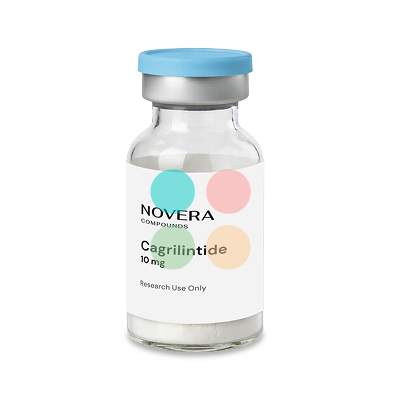
Cagrilintide is supplied as a lyophilized research peptide, intended strictly for laboratory research use only. It is not FDA-approved as of April 2026, is not formulated for human consumption or veterinary use, and cannot be legally used to treat, diagnose, or cure any disease. Every batch supplied by FillerSupplies.com under the Novera brand is designated for qualified professionals conducting scientific research in certified laboratory environments.
General Information About Cagrilintide
Cagrilintide is a 37-amino acid peptide derived from the native human amylin backbone but engineered with critical structural modifications that dramatically improve its pharmacokinetic profile. The molecule features an N-terminal lysine residue modified with a C20 fatty diacid chain via a γ-glutamyl linker, enabling reversible, non-covalent albumin binding in circulation. At the C-terminus, a proline amidation replaces the native amylin residue, enhancing resistance to proteolytic degradation. The molecular formula is approximately C₁₉₄H₃₁₂N₅₄O₅₉S₂, yielding an average molecular weight of roughly 4,409 g/mol (~4.4 kDa).
These lipidation and amino acid substitutions solve two fundamental problems with native human amylin: its extremely short plasma half-life (measured in minutes) and its well-documented tendency toward amyloid fibril formation. Cagrilintide improves stability and pharmacokinetics of native amylin, extending the elimination half-life to approximately 168–192 hours (roughly 7 days) in pharmacokinetic studies, which supports administration via a once-weekly injection protocol in clinical trial designs. Peak plasma concentrations (Tₘₐₓ) occur approximately 24–72 hours after subcutaneous dosing, depending on the dose administered.
As a dual amylin and calcitonin receptor agonist, cagrilintide’s mechanism of action centers on binding to the calcitonin receptor (CTR) and the amylin receptor subtypes AMY₁R, AMY₂R, and AMY₃R – each formed by the CTR partnered with receptor-activity modifying proteins RAMP1, RAMP2, or RAMP3, respectively. Activation of these receptor complexes engages Gₛ-protein signaling, increasing intracellular cAMP. In functional assays, cagrilintide demonstrates pEC₅₀ values in the ~10.0–10.3 range (EC₅₀ ≈ 10⁻¹⁰ M) for human AMY₃R and CTR. While this positions cagrilintide as slightly less potent in vitro than salmon calcitonin (sCT, pEC₅₀ ~11–12), its superior stability, reduced aggregation risk, and long acting pharmacokinetic profile make it far more practical for sustained receptor engagement in both animal models and clinical investigation. The mechanism of action of cagrilintide includes activating satiety centers in the brain, particularly hindbrain circuits, distinguishing it mechanistically from GLP-1 receptor agonists.
Cagrilintide Use in the Research Setting
Cagrilintide is supplied in lyophilized powder form for reconstitution and is designated for research and laboratory use only. It must be handled in certified laboratory environments using sterile technique during preparation and transfer. Below are the primary domains in which cagrilintide has been investigated.
Amylin Receptor Signaling Studies
Cagrilintide serves as a critical pharmacological tool in amylin receptor biology. Recent cryo-electron microscopy (cryo-EM) studies have resolved the structures of cagrilintide bound to Gₛ-coupled AMY₁R, AMY₂R, AMY₃R, and CTR receptor complexes. These structural data reveal a binding mode largely consistent with native amylin, but with notable differences: cagrilintide anchors via the F23 residue and forms a distinctive E14–R17 intramolecular salt bridge that stabilizes its receptor-bound conformation.
In cell-based cAMP reporter systems using transfected human or rodent receptors, cagrilintide activates both AMY₃R and CTR with high potency. However, its receptor residence time – the duration the ligand remains bound – is relatively short, on the order of 3–6 minutes, in contrast to salmon calcitonin’s residence time of approximately 45–60 minutes. This pharmacological distinction is important for researchers designing experiments that depend on sustained versus transient receptor activation.
Compared to native amylin, cagrilintide retains robust biological activity at amylin receptors while eliminating the aggregation and rapid clearance problems that limit native amylin’s utility in laboratory research. This makes cagrilintide a preferred reagent for studies requiring prolonged, consistent receptor engagement without the confounding variable of peptide instability.
Metabolic Research Applications
Cagrilintide is being studied for obesity and type 2 diabetes, with extensive data from both animal models and human clinical trials. In high-fat diet (HFD) mouse models, subcutaneous dosing at approximately 0.3, 3, and 30 nmol/kg/day over 21 days produced dose-dependent body weight reductions. At 3 nmol/kg SC, wild-type mice lost approximately 3.4 g body weight versus no significant loss in vehicle-treated controls. Critically, comparable weight loss was not observed in RAMP1/RAMP3 knockout mice, confirming that the effect depends on AMY₁R and AMY₃R signaling rather than CTR activation alone.
In a Phase 2 dose-finding clinical trial, cagrilintide was administered at 0.3 to 4.5 mg once weekly via subcutaneous injection over approximately 26 weeks. Mean weight loss ranged from ~6.0% to ~10.8% depending on dose, compared with ~3% in the placebo arm. The highest dose arms demonstrated significantly greater weight loss than liraglutide 3.0 mg administered daily (~10.8% vs ~9.0%).
“Cagrilintide’s dose-dependent weight loss in both rodent models and human Phase 2 trials, combined with its dependence on AMY₁R/AMY₃R rather than CTR alone, supports a receptor-specific mechanism distinct from calcitonin-driven effects.”
The following comparison table summarizes cagrilintide alongside related peptides investigated in metabolic research models:
| Compound |
Receptor Targets |
Half-Life / Dosing |
Weight Loss (Animal / Human) |
Potency (pEC₅₀) |
Key Limitations |
| Native Human Amylin |
AMY₁₋₃R |
Minutes; frequent dosing required |
Minimal; primarily glycemic regulation |
Very high but unstable |
Rapid degradation, amyloid fibril formation |
| Pramlintide |
AMY receptors |
Short-acting; multiple daily doses |
Modest reduction (adjunct to insulin in diabetes) |
High on AMYRs |
Frequent dosing, limited CTR activity |
| Salmon Calcitonin (sCT) |
CTR and AMYRs (non-selective) |
Longer residence time (~45–60 min at receptor) |
Variable in HFD animal models |
~11–12 |
Higher side-effect profile, poor clinical tolerability |
| KBP-336 |
CTR and AMYRs (CTR-biased) |
Long acting in rodent models |
Superior weight/glucose effects vs cagrilintide at high doses in some rodent studies |
Potent in vitro |
CTR-biased receptor balance; less clinical data |
| Cagrilintide |
AMY₁₋₃R and CTR (dual agonist) |
~168–192 h; once-weekly SC |
Human Phase 2: ~6.0–10.8% (mono); ~15.6% (with semaglutide). Dose-dependent fat mass loss in WT mice |
~10.0–10.3 |
Short receptor residence time (3–6 min); not FDA-approved |
Neuroendocrine Pathway Investigation
Cagrilintide is studied for neuroendocrine signaling pathways, with particular focus on how amylin receptor activation in the central nervous system modulates appetite and energy balance. In wild-type mice, cagrilintide activates c-Fos-expressing neurons in the dorsal vagal complex (DVC), lateral parabrachial nucleus (LPBN), area postrema, and nucleus tractus solitarius – brainstem regions critically involved in satiety signaling and suppression of food intake. These neuronal activation patterns are attenuated or absent in RAMP1/RAMP3 knockout animals, further implicating AMY₁R and AMY₃R as the functional receptors mediating these central effects.
This neuroendocrine pathway is mechanistically distinct from the hypothalamic and gut-brain circuits predominantly engaged by GLP-1 receptor agonists. Amylin analogs like cagrilintide appear to act via hindbrain satiety circuits and may also influence reward-related pathways involving AgRP and POMC neurons. Common side effects of cagrilintide observed in clinical trials include nausea and vomiting, consistent with potent activation of area postrema neurons. Differential gene expression studies in treated animals reveal changes in synaptic function and receptor trafficking genes in key brainstem regions after chronic administration.
“While GLP-1 receptor agonists primarily engage hypothalamic circuits, cagrilintide activates hindbrain satiety regions via AMY₁R and AMY₃R – an anatomically and pharmacologically complementary mechanism that underpins the rationale for combination therapies.”
<em>Important to Know:</em>
Combination Research Studies
One of the most significant areas of cagrilintide investigation involves its use in multi-peptide pathway research, particularly in combination with GLP-1 receptor agonists. CagriSema is a combination of cagrilintide and semaglutide, currently under active clinical investigation. In a Phase 2 trial, weight loss with the CagriSema combination reached approximately 15.6%, compared with cagrilintide monotherapy at ~8.1% and semaglutide monotherapy at ~5.1%. Regulatory review for the CagriSema combination therapy is ongoing.
In animal models of diet-induced obesity, co-administration of cagrilintide and semaglutide produced additive suppression of food intake, greater fat mass loss, and improved metabolic markers beyond what either compound achieved alone. Dosing in combination animal studies typically used ranges similar to monotherapy for each agent; in the human CagriSema trial, cagrilintide doses of approximately 1.0–2.4 mg weekly were administered alongside semaglutide. These combination data support the hypothesis that dual targeting of amylin receptor and GLP-1 receptor pathways – which engage anatomically and mechanistically distinct neural circuits – can produce synergistic metabolic outcomes in preclinical and clinical models.
Practical dosing ranges for researchers: in rodent metabolic models, cagrilintide has been administered at approximately 0.3 to 30 nmol/kg/day subcutaneously. In human Phase 2 clinical trials, doses ranged from 0.3 to 4.5 mg administered once weekly. Access to cagrilintide for human studies remains restricted to clinical trials under appropriate regulatory oversight.
Buy Cagrilintide Online at FillerSupplies.com
For researchers and qualified professionals seeking to buy cagrilintide for laboratory research, FillerSupplies.com offers this peptide under the Novera brand with rigorous quality control and global logistics designed for research-grade compounds. Cagrilintide 5mg is available at $49.00 with ≥99% purity, and Cagrilintide 10mg is priced at $55.00. Each batch undergoes third-party testing for purity, and the peptide is supplied in lyophilized powder form for maximum stability during shipping and storage.
- Authentic, certified products – original, quality-controlled compounds, warehouses worldwide.
- 11 years of reliability & trust – established supplier on the market since 2006.
- Temperature-controlled shipping – thermal packaging with ice gel / cold packs preserves stability.
- Express worldwide shipping – next-day dispatch, global delivery.
- Best wholesale prices – tiered bulk discounts and price-match guarantee.
- Privacy guaranteed; expert support at (888) 392-6640, WhatsApp and email, Mon-Fri 10am-6pm EST.
- Supplied for research use only, to licensed professionals.
All cagrilintide products from FillerSupplies.com are supplied strictly for research use only and are not intended for human consumption, veterinary use, or any therapeutic, diagnostic, or clinical application outside of approved investigational protocols. Cagrilintide cannot be compounded legally in the U.S. under current federal food, drug, and cosmetic act regulations – the FDA has explicitly stated that cagrilintide cannot be used in compounding under federal law. Purchasing from a verified chemical supplier with documented handling and cold-chain protocols is essential for maintaining peptide integrity.
Related research peptides available at FillerSupplies.com: Tirzepatide, Retatrutide, Tesofensine.
FAQ
What Is Cagrilintide And How Does It Work As A Research Peptide?
Cagrilintide is a synthetic analog of amylin, classified as a dual amylin and calcitonin receptor agonist (DACRA). Its mechanism of action involves binding to AMY₁R, AMY₂R, AMY₃R, and CTR receptor complexes, activating Gₛ-cAMP signaling pathways. The mechanism of action of cagrilintide includes activating satiety centers in the brain, particularly in the hindbrain, making it a valuable tool for metabolic and neuroendocrine scientific research.
Is Cagrilintide Safe For Human Or Veterinary Use?
Cagrilintide is not FDA-approved as of April 2026 and is supplied strictly for research use only. It is not intended for human or veterinary use, and it should not be used to treat, diagnose, or cure any disease outside of regulated clinical trials. Common side effects documented in clinical trial settings include nausea and vomiting, and unapproved online sources of cagrilintide pose health risks due to uncertain purity, formulation, and handling standards.
How Does Cagrilintide Compare To Pramlintide And Salmon Calcitonin?
Pramlintide is a short-acting amylin analog requiring multiple daily doses, with modest weight reduction effects primarily in diabetes settings. Salmon calcitonin demonstrates higher in vitro potency (pEC₅₀ ~11–12) but has a less favorable tolerability profile. Cagrilintide occupies a middle ground: it is a long acting peptide with a ~7-day half-life supporting once-weekly dosing, with robust dual receptor engagement and reduced aggregation compared to native amylin.
What Dosing Ranges Have Been Investigated In Research Models?
In rodent metabolic studies, cagrilintide has been investigated at approximately 0.3 to 30 nmol/kg/day administered subcutaneously. In human Phase 2 clinical trials, doses of 0.3 to 4.5 mg once weekly have been studied. All dosing information is derived from published literature and is provided for scientific research context only - not as guidance for human consumption or any therapeutic application.
How Should Cagrilintide Be Stored And Reconstituted?
Cagrilintide is supplied as a lyophilized powder and should be stored in a cool, dry place away from sunlight. It should be protected from moisture and temperature fluctuations. Upon reconstitution, use sterile technique during preparation and transfer, and the reconstituted solution should be used promptly or stored according to validated laboratory protocols. Repeated freeze-thaw cycles should be avoided to preserve biological activity.
Is Cagrilintide A WADA-Prohibited Substance?
While cagrilintide is not explicitly named on the 2026 WADA Prohibited List, it falls under category S2, which prohibits peptide hormones and their analogues and mimetics. Researchers working with athlete-exposed populations or sport-related biological samples should consult current WADA regulation before incorporating cagrilintide into any investigation protocol.
What Is CagriSema And Why Is It Being Studied?
CagriSema is a combination of cagrilintide and semaglutide currently under clinical investigation. The rationale is that amylin receptor and GLP-1 receptor pathways engage complementary neural circuits, and Phase 2 data demonstrated approximately 15.6% weight loss with the combination versus ~8.1% with cagrilintide alone and ~5.1% with semaglutide alone. Regulatory review for the CagriSema combination therapy is ongoing.
- Enebo, L. B., et al. (2021). Safety, tolerability, pharmacokinetics, and pharmacodynamics of concomitant administration of multiple doses of cagrilintide with semaglutide 2.4 mg: a phase 1b trial. The Lancet, 397(10286), 1736-1748. https://doi.org/10.1016/S0140-6736(21)00845-X
- Larsen, A. T., et al. (2022). Does receptor balance matter? Comparing the efficacies of the dual amylin and calcitonin receptor agonists cagrilintide and KBP-336 on metabolic parameters in preclinical models. Biomedicine & Pharmacotherapy, 156, 113842. https://doi.org/10.1016/j.biopha.2022.113842
- Cao, J., et al. (2025). Structural activation mechanism of cagrilintide bound to amylin and calcitonin receptors. Nature Communications, 16. https://doi.org/10.1038/s41467-025-58680-y