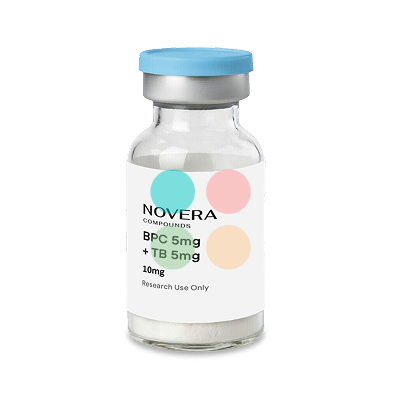
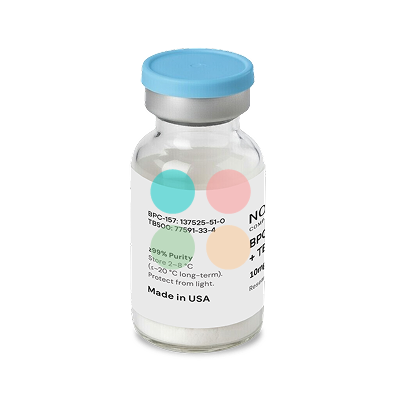
The BPC-157 + TB-500 blend combines two synthetic peptides that have attracted significant attention in preclinical tissue repair research. BPC-157, a stable gastric pentadecapeptide, promotes VEGFR2 signaling for tissue repair and angiogenesis, while TB-500 enhances cell migration and tissue remodeling through actin dynamics regulation. Together, their distinct mechanisms target non-overlapping regenerative pathways – vascular repair and cytoskeletal reorganization – offering researchers a tool to investigate potential complementary effects in wound healing, tendon healing, muscle recovery, and neuroprotection across experimental models.
This bpc 157 tb 500 blend is supplied by FillerSupplies.com under the Novera brand exclusively for laboratory research use. It is not approved for human or veterinary use by the FDA, and no controlled clinical trials have evaluated the combined administration of these peptides in humans. All findings referenced below derive from animal studies, in vitro assays, or mechanistic analyses in the published literature.
General Information About BPC-157 + TB-500 Blend
BPC-157 is a 15-amino-acid synthetic peptide derived from a protective protein found in human gastric juice. Its full sequence – Gly-Glu-Pro-Pro-Pro-Gly-Lys-Pro-Ala-Asp-Asp-Ala-Gly-Leu-Val – makes it a pentadecapeptide with notable gastric acid stability, a property that distinguishes it from most peptides of comparable size. TB-500 is a synthetic fragment corresponding to residues 17–23 of the full-length thymosin beta 4 protein (43 amino acids, ~4,920 Da). The fragment’s acetylated sequence, Ac-LKKTETQ, has a molecular weight of approximately 889 Da and retains the actin binding domain responsible for the parent molecule’s biological activity.
At the molecular level, BPC-157 activates the VEGFR2/Akt/eNOS signaling cascade. Research demonstrates that it upregulates VEGFR2 expression and internalization in endothelial cells, triggering Src–caveolin-1 dissociation and the subsequent release of endothelial nitric oxide synthase (eNOS). Nitric oxide release downstream of this cascade mediates vascular protection, new blood vessel formation, and focal adhesion kinase activation in preclinical injury models. TB-500, by contrast, operates through a fundamentally different pathway: the LKKTETQ motif binds monomeric G-actin in a 1:1 stoichiometry, sequestering actin monomers and thereby modulating actin polymerization and f actin formation. This actin regulation enables cytoskeletal reorganization, cellular migration, and survival signaling through PI3K/Akt and integrin-linked kinase (ILK) pathways.
Pharmacokinetic data for BPC-157 comes from rat and dog studies. After intravenous dosing at 20 µg/kg in rats, the elimination half-life measured approximately 15.2 minutes; intramuscular administration yielded half-lives of 7.9–29.7 minutes depending on dose, while dogs showed IV half-lives of roughly 5.27 minutes and IM half-lives of 20.0–29.3 minutes. The peptide becomes undetectable within about four hours post-dose in both species. A reliably published systemic half-life for the TB-500 fragment specifically has not been established in peer-reviewed literature; most pharmacokinetic data pertains to full-length thymosin beta 4. Despite short plasma half-lives, both peptides demonstrate prolonged biological activity in preclinical injury models, suggesting tissue-level retention or sustained downstream signaling beyond their circulatory presence.
BPC-157 + TB-500 Blend Use in the Research Setting
The BPC-157 + TB-500 blend is supplied as a lyophilized powder for research and laboratory use only. Below, the key research domains where these peptides have been investigated – individually and by mechanistic extrapolation as a blend – are outlined with specific findings, mechanisms, and comparisons.
Angiogenesis and Vascular Repair
Blood vessel formation represents one of the most extensively studied properties of BPC-157 in preclinical research. Sikiric et al. published a 2013 review in Current Pharmaceutical Design demonstrating that BPC-157 acts through nitric oxide, VEGF, and focal adhesion kinase pathways to optimize vascular responses following endothelial damage, thrombosis, or ischemia in rat models. BPC-157 enhances angiogenesis through VEGFR2 signaling – specifically, it induces receptor internalization in HUVECs (human umbilical vein endothelial cells), activating the Src–caveolin-1–eNOS axis and promoting new blood vessel formation at injury sites.
TB-500 supports systemic recovery and cell migration in vascular contexts through a different mechanism. The parent thymosin beta 4 molecule has demonstrated angiogenic effects in cardiac injury models, increasing endothelial cell movement, capillary density in wound beds, and overall vascularization. Most in vivo vascular data, however, derives from full-length Tβ4 rather than the synthetic fragment. BPC-157 stabilizes blood vessels while TB-500 enhances cell movement – a mechanistic pairing that research suggests could produce combined effects on vascular repair, though no published study has tested co-administration in a controlled vascular injury model.
Compared to growth factor therapies such as recombinant VEGF administration, which carry risks of uncontrolled angiogenesis and edema, BPC-157 appears to modulate rather than maximally stimulate angiogenic signaling. The up regulation of VEGFR2 by BPC-157 is receptor-mediated and dose-dependent, in contrast to exogenous VEGF flooding. GHK-Cu, another peptide investigated for vascular applications, supports collagen synthesis and tissue organization but operates through copper-dependent metalloproteinase pathways rather than the eNOS cascade.
Tendon and Ligament Regeneration
Preclinical data on tendon healing with BPC-157 is among the strongest in the peptide’s research portfolio. In rat models involving Achilles tendon transection, BPC-157 applied systemically or locally produced increased collagen deposition, faster tensile strength recovery, and improved tendon-bone junction healing over approximately 14 days. BPC-157 accelerates muscle-to-bone junction repair in rats, with biomechanical testing showing significantly restored tensile properties relative to untreated controls. The mechanism involves VEGFR2-mediated vascularization of the healing tendon and promotion of growth factor receptor expression in tendon fibroblasts.
TB-500 promotes cell migration and cytoskeletal organization, properties particularly relevant to tendon outgrowth and structural remodeling. Full-length Tβ4 in tendon and ligament injury models has demonstrated enhanced fibroblast migration, increased matrix metalloproteinase (MMP) expression, reduced scar formation, and improved alignment of collagen fibers. Data specifically for the TB-500 fragment in healing tendons is less abundant, though the actin binding protein interaction responsible for cellular movement is preserved in the fragment sequence.
Their synergy leads to improved collagen organization and healing – at least in theory. The rationale for combined administration rests on non-overlapping pathways: BPC-157 drives vascular supply and growth factor signaling to injury sites, while TB-500 facilitates the fibroblast migration and actin dynamics necessary for matrix deposition. Findings suggest that this mechanistic complementarity could produce synergistic effects, but no published study has compared the blend against individual peptides in the same tendon repair model.
|
Research Parameter
|
BPC-157 Alone (Rodent Data)
|
TB-500 / Full Tβ4 Alone (Rodent Data)
|
Blend (Co-administered) Evidence
|
|
Collagen deposition in tendon repair
|
Increased collagen content and strength vs. control after ~14 days in rat Achilles transection models
|
Full Tβ4 increased fibroblast density and collagen alignment; fragment-specific data limited
|
No published controlled study comparing blend vs. individual peptides in matched tendon models
|
|
Biomechanical strength recovery
|
Restored tensile strength significantly faster vs. untreated controls in ligament transection (weeks)
|
Full Tβ4 improved tensile strength and elasticity; fragment less well quantified
|
Blend effect not tested in head-to-head preclinical designs
|
|
Primary mechanism
|
VEGFR2/eNOS/nitric oxide; growth hormone receptor promotion in tendon fibroblasts
|
Actin binding (LKKTETQ), cell migration, ILK/Akt, MMP induction
|
Rationale based on non-overlapping pathways; additive or synergistic effect not experimentally demonstrated
|
|
Fibroblast activity
|
BPC-157 increases fibroblast migration for tissue repair and enhances fibroblast survival at injury sites
|
TB-500 enhances fibroblast migration and cellular migration through cytoskeletal reorganization
|
Combined BPC-157 and TB-500 may double recovery rates based on mechanistic extrapolation, not direct measurement
|
Muscle Injury Recovery
BPC-157 has shown a promoting effect on muscle tissue recovery in several preclinical paradigms. Studies using gastrocnemius muscle crush injury models in rats demonstrate enhanced myofiber regeneration, reduced fibrosis, and improved strength recovery following peptide administration. BPC-157 enhances fibroblast migration during tissue repair and appears to activate satellite cells – the resident stem cell population responsible for muscle regeneration. These findings extend to post surgical healing contexts, where structural remodeling of damaged muscle tissue accelerated relative to controls.
TB-500 contributes to muscle recovery through actin dynamics and cellular movement facilitation. The peptide’s actin binding capacity modulates actin production and f actin formation, enabling the cytoskeletal reorganization required for myoblast migration into damaged areas. TB-500 reduces inflammatory cytokines during tissue recovery, including pro inflammatory cytokines such as TNF-α and IL-6, thereby creating a microenvironment more conducive to regeneration than inflammation.
In an isolated rat aortic ring assay, BPC-157 at 10–100 µg/mL produced concentration-dependent vasodilation and activated Src–caveolin-1–endothelial nitric oxide synthase signaling; blocking receptor endocytosis abolished the effect – indicating that VEGFR2 internalization is essential, not incidental, to the vascular mechanism.
Direct quantitative comparisons of faster recovery rates for the blend versus each peptide alone do not exist in controlled animal studies. The majority of data on the pairing comes from animal models, and combined effects in muscle injury remain inferred from complementary mechanisms rather than measured in co-administration experiments. Some strain-induced and post-surgical injury models have been proposed for future blend testing, but results have not yet been published in peer-reviewed journals.
Wound Healing and Tissue Repair
Wound repair research with BPC-157 spans topical and systemic application routes in rodent dermal wound models. The peptide accelerates granulation tissue formation, re-epithelialization, and the collagen III–to–collagen I transition critical for mature scar strength. Modulation of inflammation at injury sites – decreased TNF-α and IL-6 levels specifically – contributes to a tissue remodeling environment that favors organized repair over disordered fibrosis. Combined, BPC-157 and TB-500 accelerate wound healing based on the convergence of vascular supply (BPC-157) and cellular migration machinery (TB-500).
Full-length thymosin beta 4 has demonstrated wound healing efficacy in corneal, dermal, and cardiac scar models, reducing apoptosis and increasing revascularization. The TB-500 fragment preserves these wound repair properties to a degree, though published evidence for the fragment alone in dermal wounds is more limited than for the parent molecule. BPC-157 specifically has a history of reducing gut inflammation, and this anti-inflammatory capacity extends to dermal tissues in experimental models where it downregulates pro inflammatory cytokines systematically.
Compared to standard wound healing research protocols using growth factor application (e.g., PDGF, EGF), the peptide blend’s mechanism is broader – engaging both vascular repair and cytoskeletal pathways simultaneously. Combined, BPC-157 and TB-500 accelerate tissue repair processes through what researchers describe as potential complementary effects rather than simple additive action.
Important to Know: All wound healing and tissue recovery data referenced above derive exclusively from animal or in vitro models. No large, rigorous human wound studies exist for either peptide individually – only very limited pilot work for BPC-157 in select indications – and none for the combination. Both peptides are not approved for human use by the FDA. BPC-157 and TB-500 are prohibited substances on the World Anti-Doping Agency Prohibited List: TB-500 under S2 (growth factors) and BPC-157 under S0 (non-approved substances). Clinical studies supporting benefits of the two-peptide preparation are largely absent, and long-term safety data for the pair is lacking. Compounded drugs like the paired formulation are not FDA-approved and lack pre-market review.
Neuroprotection Studies
Neuroprotective research with these peptides draws primarily from full-length thymosin beta 4 and, to a lesser extent, BPC-157 in central nervous system injury models. Full-length Tβ4 administered after middle cerebral artery occlusion in mice reduced infarct volume by approximately 35% at 72 hours, with ILK/Akt pathway activation underpinning neuronal survival. The protein promotes neurogenesis, reduces microglial activation, and enhances cell survival in stroke models – properties relevant to stem cell differentiation and neural tissue recovery.
Full-length thymosin β4 administered after middle cerebral artery occlusion in mice reduced infarct volume by approximately 35% at 72 hours, with ILK/Akt pathway activation underpinning neuronal survival – one of the most quantitatively striking neuroprotection findings in the Tβ4 literature.
BPC-157 has also demonstrated neuroprotective effects in rat models of spinal cord compression, preserving motor function and reducing neuronal cell death. Whether the TB-500 synthetic fragment crosses the blood-brain barrier or maintains stability in central nervous system tissues remains unknown – a critical evidence gap, since most neuro-focused data involves the full 43-amino-acid thymosin beta 4 rather than the 7-amino-acid fragment. Compared to other neuroprotective research compounds such as cerebrolysin or NAD+ precursors, the peptide blend’s vascular and cytoskeletal mechanisms represent a distinct approach to neural tissue recovery, but one with considerably less clinical validation. Neither BPC-157 nor TB-500 has established human dosing regimens for any indication, including neurological applications.
Buy BPC-157 + TB-500 Blend Online at FillerSupplies.com
FillerSupplies.com offers the bpc-157 & tb-500 blend for sale as a research-grade lyophilized preparation under the Novera brand. Licensed researchers seeking a bpc 157 tb 500 10mg blend for sale can order directly through the online store, with global delivery and temperature-controlled transit to preserve peptide integrity. Purchasing BPC-157 and TB-500 online can carry risks of contamination and incorrect dosing when sourced from unverified suppliers – FillerSupplies.com addresses these concerns through established quality-control protocols and over a decade of market presence. Combining the co-administered pair in a single vial can present stability issues, so researchers should consult product specifications and storage guidance upon receipt.
-
Authentic, certified products – original, quality-controlled compounds, warehouses worldwide.
-
11 years of reliability & trust – established supplier on the market since 2006.
-
Temperature-controlled shipping – thermal packaging with ice gel / cold packs preserves stability.
-
Express worldwide shipping – next-day dispatch, global delivery.
-
Best wholesale prices – tiered bulk discounts and price-match guarantee.
-
Privacy guaranteed; expert support at (888) 392-6640, WhatsApp and email, Mon-Fri 10am–6pm EST.
-
Supplied for research use only, to licensed professionals.
All BPC-157 + TB-500 blend products from FillerSupplies.com are intended exclusively for laboratory research. They are not approved for human or veterinary use, and researchers bear sole responsibility for compliance with applicable local, national, and institutional regulations.
FAQ
What Is BPC-157 + TB-500 Blend and How Does It Work in Research?
The blend combines BPC-157, a 15-amino-acid stable gastric pentadecapeptide, with TB-500, a synthetic fragment of thymosin beta 4. BPC-157 promotes VEGFR2 signaling for tissue repair and nitric oxide release, while TB-500 regulates actin polymerization and fibroblast migration. Their distinct mechanisms - vascular repair and cytoskeletal reorganization - provide a rationale for investigating potential complementary effects in preclinical tissue repair and wound healing models.
Is BPC-157 + TB-500 Blend Safe for Laboratory Research Applications?
Both peptides have demonstrated high tolerability in animal studies. BPC-157 shows no adverse effects under prolonged exposure in rodent models, and TB-500 is well tolerated up to 60 mg/kg in studies. No systemic toxicity was reported for BPC-157 or TB-500. However, long-term safety data for BPC-157 and TB-500 is lacking, and potential adverse effects of administration include injection site pain and headaches in anecdotal reports. Safety profiles for the combined blend have not been formally characterized.
How Does BPC-157 + TB-500 Blend Compare to Individual Peptides in Studies?
No published controlled study has directly compared co-administration of BPC-157 and TB-500 against each peptide alone in matched experimental conditions. The rationale for blending rests on their non-overlapping pathways: BPC-157 drives vascular repair and angiogenesis via VEGFR2/eNOS, while TB-500 facilitates cellular migration through actin binding. BPC-157 and TB-500 should be administered separately, not mixed, according to some researchers who note that combining them in a single vial can present stability issues.
What Are Typical Research Dosing Ranges for BPC-157 + TB-500 Blend in Animal Models?
In published animal studies, BPC-157 has been dosed at 20 µg/kg IV and 20–500 µg/kg IM in rats, and 6–150 µg/kg in dogs. TB-500 fragment dosing in research varies, often in the micromolar range for cell culture or extrapolated from full-length Tβ4 literature for in vivo work. Neither BPC-157 nor TB-500 has established human dosing regimens, and the blend specifically lacks published dose-response data.
How Should BPC-157 + TB-500 Blend Be Stored and Reconstituted for Research?
The lyophilized powder should be stored at −20°C for long-term stability. Once reconstituted with bacteriostatic water, refrigerated storage (2–8°C) is recommended, with use within days to a few weeks. Repeated freeze-thaw cycles should be avoided, as both peptides are sensitive to temperature fluctuation and light exposure. Researchers should verify molecular identity - BPC-157 as the 15-amino-acid pentadecapeptide and TB-500 as Ac-LKKTETQ (CAS 885340-08-9) - to confirm product authenticity.
Is BPC-157 + TB-500 Blend Prohibited by WADA or Other Regulatory Bodies?
Yes. BPC-157 and TB-500 are prohibited substances on the World Anti-Doping Agency Prohibited List. TB-500 falls under category S2 (growth factors), and BPC-157 under S0 (non-approved substances). The FDA has placed both peptides on the Category 2 list of bulk drug substances of safety concern, effectively limiting compounding pharmacy use. Both peptides are not approved for human use by the FDA, and compounded drugs like BPC-157 and TB-500 lack pre-market review.
Where Can Licensed Researchers Buy Authentic BPC-157 + TB-500 Blend?
Licensed researchers can purchase the bpc-157 & tb-500 blend for sale through FillerSupplies.com, which supplies the Novera-brand product with temperature-controlled shipping and global delivery. Purchasing BPC-157 and TB-500 online can carry risks of contamination and incorrect dosing from unverified sources, making supplier reputation and quality-control practices essential considerations. FillerSupplies.com has operated since 2006 and ships exclusively to licensed professionals for research use.